Introduction
The following attempts to articulate how assembly theory – a novel development in origins-of-life research – provides empirical traction for a process-relational interpretation of evolution. Assembly theory defines objects through their historical construction rather than by reference to external coordinates. By tracing the informational lineage encoded within objects, it submits that accounting for unrealized possibility in the definition of matter is essential to a more comprehensive understanding of life. Process philosophy likewise sees objects as processes. Everything is what it is, in and as a process of becoming. Essential to making things what they are is everything they inherit from the past, could be in the future, and the possibilities enabled and forgone by their development. From a process-relational perspective, the universe feels itself as the creative actualization of possibility. From the viewpoint of assembly theory, the universe is a process of enfolding, where history avails and omits possibilities as life recursively constructs itself.
The cosmological view put forth by 20th century mathematician and philosopher Alfred North Whitehead is deeply congruent with assembly theory despite sharing virtually no intellectual overlap. This paper will identify key similarities between the two frameworks, then highlight how each can serve the other and invite fruitful dialogue. It will begin with expositions of assembly theory and Whitehead’s Philosophy of Organism with special attention to the epistemic foundations of each. A concrete example will recapitulate the assembly theoretic framework in Whiteheadian terms before acknowledging important points of divergence and inviting assembly theory towards a process-relational worldview with the assistance of contemporary cognitive science.
Assembly theory is a laboratory science. Like any other, it grows out of philosophical positions that give its practitioners reason to pursue a particular experimental path. This paper compares assembly theory to process philosophy on the basis of its underlying philosophical inspiration, where its scientific findings will be taken as agnostic to any sufficiently compatible philosophical framework.[1] Central themes shared by assembly theory and process philosophy are then identified as: (i) objects as historically constituted processes, (ii) evolutionary development that is neither deterministic nor ergodic, (iii) a causal (rather than purely geometric) characterization of time, and (iv) a view of consciousness as the capacity for imagined counterfactuality. Process philosophy, however, importantly looks beyond the conceptual bounds of assembly theory by affirming experience as a fundamental aspect of the cosmos and emphasizing a participatory relation to Nature at large. It will be argued that assembly theory helps render an embodied sense of relevance explicit in the origins of life when bolstered by process philosophy and cognitive science. The resulting gestalt is an empirically grounded view of Nature which has little issue seeing life and the subjectivity it harbors as exemplifying adaptive and creative capacities across physical, chemical, biological, psychological, and technological evolution. Integrating assembly theory within a panexperientialist process philosophy opens pathways towards deeper understandings of evolution – ones that do not just objectify the universe but also recognize the essential role of subjectivity in its development.
Assembly Theory
Nothing in the universe pops into existence pre-made. Every object is constituted of others that have interacted to construct it. Most accounts of evolution conveniently take DNA as a starting point and explain selection in its terms, yet a compelling account of how DNA comes about in the first place is missing. DNA had to be preceded by simpler molecules ready to serve as its components. The explanatory gap at the bottom of the prevailing evolutionary narrative begs an extension of selection beyond genetics. Even if the precise origins of our particular genome were known, it would remain unclear whether carbon-based nucleotides are the only possible means by which complex life evolves (or, as Ball (2023) points out, whether DNA actually plays the role in morphology it’s traditionally assumed to). A better understanding of the origins of life requires a clearer picture of the dynamics that encourage molecules to arrange themselves into increasingly complex structures. Assembly theory thus takes aim at the chemical selection that precedes genetic selection in order to study evolution in terms more general and fundamental than Dawkins’s (1976) famous “selfish genes”. Extending the term “selection” this way may feel foreign to some, but such semantic pretense doesn’t render the question of DNA’s construction any less consequential or the insights of assembly theory any less generative (Jaeger, 2024). A more robust account of life requires a closer observation of the possibilities ensconced within physical material.
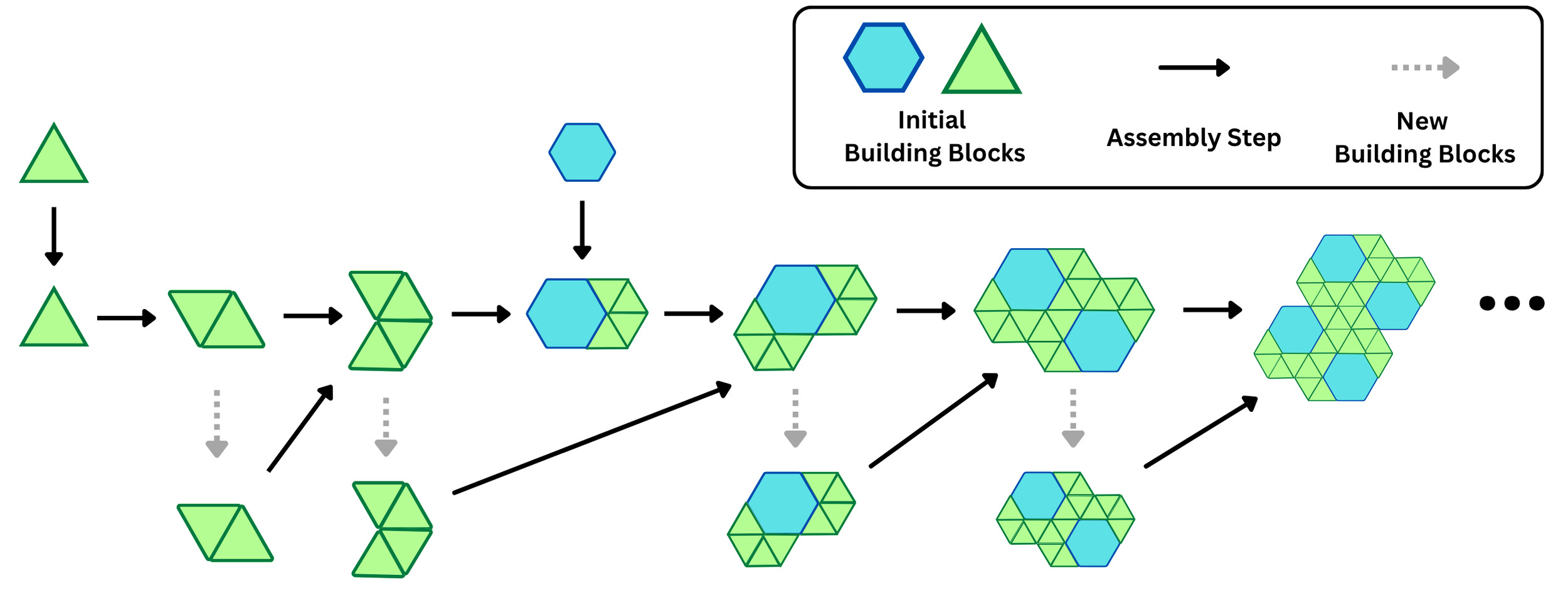
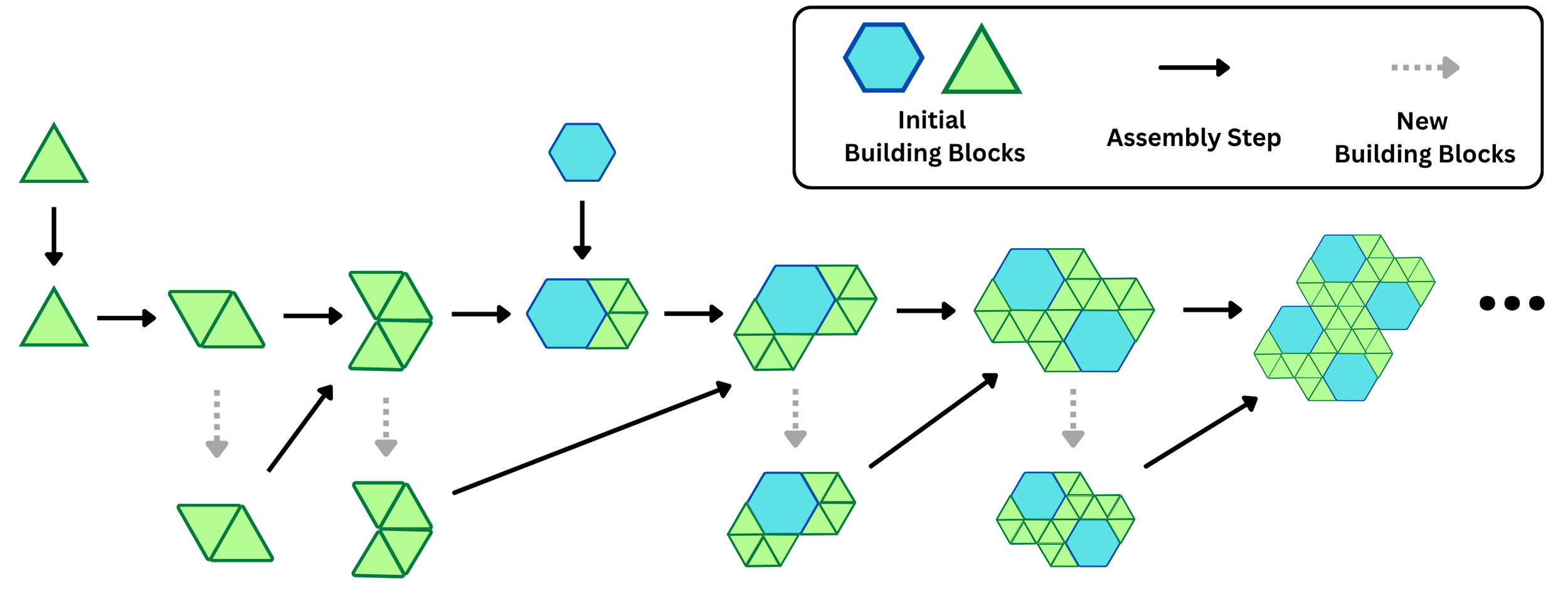
Traditional physics works by predicting trajectories against the backdrop of an externalized spacetime. It starts from an observed set of initial conditions and extrapolates future states that must follow deterministically. Instead of focusing only on external relations, assembly theory draws attention to the memory embedded inside of objects. As atoms bond with one another, they form building blocks which can in turn recombine to form even more complex structures to serve as the building blocks for others, and so on. Each combination of two building blocks is an assembly step. There are myriad ways two building blocks can combine in an assembly step. Plus, when two building blocks do connect, they compound into a new building block that adds itself to the inventory of usable components for subsequent steps. Thus each assembly step not only adds to the complexity of the existent object but also expands and refines the possibilities available for later steps (See Figure 1).
Crucially, assembly steps are viewed through the lens of combinatorial possibility, not traditional spatiotemporal extension. Assembly theory analyzes how molecules form increasingly complex structures by working within an assembly space. An assembly space is the array of possible constructive paths an object could have taken into existence. “For a given object, the assembly space is defined as the pathway by which that object can be built from elementary building blocks, using only recursive operations combining what has already been built in the past” (Walker, 2024, p. 46). Assembly space is not concerned with the actual construction of a particular object, but the combinatorial space of all the possible assembly steps that could arrive at an object featuring the same molecular structure given a set of rules compatible with the laws of physics. There are many ways the building blocks which make up a molecule could have been combined and recombined to construct it over time. The molecule is defined by this range of possible histories its structure instantiates. It’s analyzed through the lens of all the possible paths it could have taken, not the singular one it may have. Assembly theory thus inserts an aspect of possibility into the very definition of physical objects.
The minimum number of steps required to construct an object is defined as its assembly index. The higher the assembly index, the greater number of historically contingent steps required to construct it. It defines the shortest possible assembly pathway (ordered sequence of assembly steps) through the assembly space necessary to construct an object. Because there are a multitude of ways two building blocks can assemble and each step adds to the number of available building blocks, the number of possible molecular structures grows super-exponentially with each assembly step. With even just a few assembly steps, the number of possible constructions explodes into a vast array. Each incremental step selects from a virtually innumerable range of options. Assembly theory begins by pointing out that the existence of even relatively mundane molecules relies on the occurrence of many immensely improbable steps.
The copy number represents how often identical molecular structures appear in a given sample. The higher the copy number, the more abundant the structure. Copy number and assembly index are combined to form the assembly number. The assembly number approximates how much selection is nested inside of an object by looking at how many identical structures it has that feature a high assembly index. A high assembly number indicates that something in the environment is reliably producing complex structures – such as a cell producing the components it needs to subsist or factories manufacturing smartphones. If the process of chemical construction were to progress on a purely random basis, we would find a universe of tar – a mush of relatively low complexity objects eating up all the finite resources available. Enormously complex objects like DNA would never get the chance to exist because the universe’s finite resources would have already been consumed by chemical trial-and-error (Walker & Cronin, 2023). For complex objects to exist in abundance, selective pressures must bias the process of construction. Assembly theory leverages this insight to infer the presence of selection at the level of simple molecules. When a high copy number of objects featuring a high assembly index are found, a selective process is assumed to be at play because such a circumstance is impossible on the basis of random construction. Assembly theorists use this inferential framework to conjecture that objects with an assembly index greater than or equal to fifteen steps are effectively impossible to form in detectable quantities without the influence of selective processes (Sharma et al., 2023). Everything below fifteen is indistinguishable from random construction, and random construction is shown to be inadequate for creating the diversity of complex intelligences that blanket the Earth.
Assembly theory submits that the origins of life can be outlined through the presence of many identical high-assembly objects because selection stabilizes complex constructs that are costly to discover but cheap to copy. After a structure has been made once, it’s evidently more likely to be produced again, especially if it represents a useful building block for more complex objects. The reuse of building blocks instantiates a memory of what’s been built before. Past constructive steps are stored in present structures.
Memory separates living structures from sophisticated structures that occur without any recursive construction. Rocks and hurricanes organize simple molecules to create systems that seem incrementally more complex, yet the assembly index of their components remains low; each is formed by externally induced regularity rather than internally constructed memory. The molecules of water in a hurricane form a large, complicated structure in response to external forces without any memory enabling complex growth through recursive construction. Cells and phones, by contrast, are packed with diverse high-assembly structures that recur in enormous copy numbers. Assembly theory thus arrives at a measure of complexity by determining the amount of memory required to reliably produce an object – the more memory required, the more complex the object. [2]
This new internal measure of memory deepens the context of time by viewing objects as stepwise processes rather than snapshots of a predetermined actuality. The more complex the object, the greater number of steps required to make it and the more causal depth it holds within itself. Here time is defined in terms of causal steps rather than externally defined minutes and seconds. The classical move to spatialize time into a vacuous field is taken to be a helpful but partial perspective. “If the theory holds, its most radical philosophical implication is that time exists as a material property of the complex objects created by evolution. That is, just as Einstein radicalised our notion of time by unifying it with space, assembly theory points to a radically new conception of time by unifying it with matter” (Walker & Cronin, 2023). For assembly theory, time is embedded within path-dependent construction. Two objects may exist simultaneously but have vastly different “temporal thickness”. Simple objects like rocks – even if existing in their current form for millions of external years – are temporally shallow relative to the immense number of steps it took for a human or their smartphone to sprout out of the Earth. The lithium in the smartphone battery may be billions of years “older” than the freshly fabricated phone it makes possible, yet the phone as a whole holds within itself a causal (i.e. temporal) depth that far exceeds the number of steps required to make lithium. Viewed through the lens of assembly theory, objects instantiate an internal, yet directional time grounded in causal history as opposed to the traditional temporal dimension projected onto objects externally.
Constructing Information
The epistemic thrust of assembly theory’s novelty comes from its practical application of constructor theory. The details and implications of constructor theory are vast and beyond what there is room for in this paper. The following details constructor theory strictly in what’s felt as necessary to the introductory confluence of assembly theory and process philosophy.
Constructor theory starts by defining constructors as “anything that can cause transformations in physical systems without undergoing any net change in its ability to do so” (Deutsch, 2013). Constructors perform tasks on physical substrates. Tasks are abstract input output transformations that either can or cannot be performed. Substrates are anything physical the task is performed on. Attributes are physically allowed conditions of substrates. Once a task is complete, the constructor remains capable of repeating it (such as in combustion engines, catalytic enzymes, manufacturing processes, or computers). Real constructors, of course, are imperfect in their transformations and degrade over time. The constructors of constructor theory are imagined ideals. A task is deemed possible if it can, in principle, be repeatedly performed with arbitrarily high fidelity.
Whereas conventional physics is stuck “pressing play” on given initial conditions, constructor theory reformulates fundamental statements in terms of possible and impossible tasks that could be reliably produced by an ideal constructor. The constructor doesn’t have to exist; it only has to be possible in principle. Constructor theoretic statements are thus inherently counterfactual – physics becomes about what could happen in principle rather than applying laws of motion to a particular instance. It works in a space of possible transformations where reference to increments of movement are made secondary to more direct statements about what transformations are possible. Physics thus obtains a broader scope and is better able to approach places where the existence of reliable transformation takes precedence over predicting a specific trajectory. Ribosomes can build proteins. A perpetual motion machine is impossible. A computer can execute a function. Cumbersome details (protein folding, statistical mechanics, complex systems of transistors) can be captured into simple statements about what transformations are possible. The laws of physics still apply in the same way, but they are now less focused on tracking objects through spacetime and more concerned with articulating the bounds of what is possible. Constructor theory loosens the bounds of the physical from an unconscious reduction of physics to mechanical motion. All that matters is whether a physical transformation is possible, not whether every component of a transformation can be followed across a spatiotemporal set of positions.
Even more importantly, constructor theory integrates information directly into physical law. Traditional notions of initial conditions and laws of motion fix the physical universe along one unified trajectory. Information by contrast depends on at least two possible states. A bit carries information because it can be 0 or 1. If something has only one possible state, it carries no information. If nothing can vary, there is no message to behold. Constructor theory defines information in physical terms by embracing its counterfactual nature. Its reformulation of physical laws allows it to talk about information without treating it as a higher-level description of dynamical processes, an a priori substance, or backing into it statistically (as Shannon information does).
In constructor-theoretic terms, information is instantiated when a constructor can effectively conduct the task of copying. It is defined by information variables acting on information media. Information variables are attributes of a substrate for which every permutation is a reversible task – meaning an input state can create an output state without itself being destroyed (i.e. it can be copied). A substrate that has an information variable as an attribute is an information medium. In the biological context, a ribosome is a constructor, and nucleotides are substrates (information media) that carry copyable genes (information variables). When a genome is sequenced, a computer performs the construction task of copying the genetic information variable into a silicon substrate. Every part of the process is permitted by physical laws, “whether or not information media exist, i.e. whether or not information can be instantiated in physical systems, depends on the laws of physics…dynamical laws permitting information media must allow information variables—i.e. replicable sets of attributes” (Marletto, 2015, p. 4). Importantly, copyable information requires that a system can exist in multiple distinguishable states. For a copying operation to work, there must be counterfactual alternatives. A system with only one possible state cannot store, transmit, or copy – there would be no comparative context from which information could be distinguished and reproduced.
The constructor definition of information then flows into a constructor definition of knowledge. “[Knowledge] is information that can act as a constructor and cause itself to remain instantiated in physical substrates” (Marletto, 2015, p. 5). Knowledge is a constructor that permits information to physically instantiate and perpetuate itself. Genes that spread through a population are a certain kind of knowledge, just as are scientific theories that survive generations of criticism. Each enable enormous physical transformations that are otherwise impossible. Genes help molecules become cells that can specialize into complex organisms. Agriculture and molecular biology allowed human beings to drape the Earth in genetically modified crops.
Information and knowledge stand above what is physical but are not independent of physical construction. “Mathematical truth is absolutely necessary and transcendent, but all knowledge is generated by physical processes, and its scope and limitations are conditioned by the laws of nature” (Deutsch, 2011, p. 188). What we can know depends on what can be physically instantiated as knowledge. Knowledge, however, is not a static remnant or untouchable statement. Whether genes or scientific theories, knowledge depends on error-correction. In its direct inheritance from Popper (1972) this definition of knowledge requires no subject. It claims to ground itself on a purely objective basis as explanations that are hard-to-vary become increasingly comprehensive in their description of Nature. Science creates ever-more-accurate explanations through perpetual criticism and refinement. Knowledge is not captured in statements that are perpetually true but is physically constructed from the never-ending search for better explanations (Deutsch, 2011, pp. 78–105). Knowledge needs no sense-making subject; it’s nothing more than the objective content embodied in theories that survive criticism.
Walker and Davies (2013) follow this line of thought to “identify the transition from non-life to life with…a transition to a state in which algorithmic information gains direct context-dependent, causal efficacy over matter” (p. 2).[3] Like Deutsch’s knowledge, life is constructed by information that influences how matter complexifies. The influence of information may not be an unnatural intrusion but could itself reflect how life probes what is possible. If there is only a singular actuality blindly following laws of motion, everything that exists is predetermined by an immaculate set of initial conditions. There is just one path that was always going to occur. Oppositely, if the universe is ergodic, every possible path occurs and initial conditions don’t matter; you can get everywhere from anywhere. Contrary to these two incompatible views, assembly theory grows out of the suspicion that our lives were neither predetermined at the big bang nor the inevitable outcome of infinite wandering. Instead, physical systems that encode information are more likely to exist because they live where lots of possible states connect (Walker, 2015). It may be that instantiating information allows physical systems to navigate counterfactual possibilities without actualizing them. Life follows from the universe’s perfectly natural use of information to explore, expand, and refine the horizon of available possibilities.[4]
An object’s very existence is evidence that a certain amount of information (how it can be constructed) has been instantiated and preserved in the world (in molecules, languages, smartphones, etc.). Objects do not just exist in the flat actuality of the moment under analysis; they also stand atop a path of historically contingent possibility. By cutting through the shallowness of externally measured time, assembly theory creates a doorway for selection to enter the story of evolution as information that is taking on causal influence prior to the construction of DNA. It blends the boundaries of physics, chemistry, biology, and information theory by reframing the temporal context within which physical matter is traditionally understood. In doing so, it extends the lower bound of discernible evolutionary processes into otherwise apparently inert molecular milieus.
The recognition that even apparently very simple objects hold evidence of evolutionary processes inside of themselves exemplifies the exact kind of development Whitehead would have anticipated. For him too, what exists are “hows” not just “whats”; what things are is how they become. Time is embedded in how objects actualize possibility. Assembly theory and process philosophy are kindred spirits in that each reframes objects as processes to broaden the scope of evolution and deepen time beyond a superficial sequence of instants.
Whitehead’s Process Philosophy
In Whitehead’s Philosophy of Organism, the world consists of fundamental units of experience, called actual occasions or actual entities (synonymous terms). They are discrete, atomic, units of becoming or “drops of experience” which may be broken down into phases but not into smaller increments of actuality (Whitehead, 1929/1978, p. 28). Not to be conflated with a neuron firing or the birth of a thought, actual occasions are how history is unified and rolled forward in indivisible instances of experience. Each actual occasion has a physical pole and a mental pole. The physical pole provides actual occasions with their causal inheritance. Through it, history influences what actualizes, constrains and avails subsequent possibilities, and provides actual occasions with the causal momentum to become. The objective data of the world is carried from past actual occasions as they give way to the becoming of new ones. Concurrent with the influence of the past is the ingression of a budding future flowing through the mental pole as valuation and conceptualization. The mental pole is how actual entities feel eternal objects. Eternal objects are pure potentials (relations, patterns, mathematical structures) which can become actual. Eternal objects importantly differ from the fixed character of Platonic Forms; they do not stand above actuality but are dependent on its dynamism. They are only potential until actualized in concrescence. Concrescence is the process by which an actual occasion’s inheritance of the past through the physical pole and anticipation of future possibilities through the mental pole are unified into a single concrete experience. Upon completing its process of concrescence, an actual occasion perishes as a subject and becomes a superject – an objective datum for later occasions. Each concrescence takes in the whole of reality and adds to it the contributions of its actualized existence, “the many become one, and are increased by one” (Whitehead, 1929/1978, p. 32).
As each actual occasion concresces, its subjective result can be felt objectively by its descendants as prehensions. Differing from the blind collisions of mechanical matter, prehensions are fundamentally experiential. They are how the universe feels itself in the process of becoming. Feelings are not a feature only of nervous systems, but an inherent facet of how the universe causally relates to itself. Prehensions provide the causal structure of evolution where causality has both objective and subjective dimensions. Sensation is not an overlay atop of a purely objective causality but is itself an integral aspect of how the world becomes. Prehensions have a vector character, meaning they are directional. The past is felt in the present as one actual occasion perishes and is inherited by another. Experience thus becomes an inherent aspect of the universe without recourse to imbuing a presumed substance with new ontological characteristics. There are no substances for Whitehead, only relations that become actual experiences.
Agency emerges as actual occasions grow into complex societies. Actual occasions organize experience, and the processes of becoming they inhabit influence the society they constitute. The more sophisticated the society, the greater novelty it can introduce via the mental pole and the richer its field of experience. A dancer has more agency than a dog, a dog more than a diatom, and a diatom more than dust. Dust is not a society, however; it is a mere aggregate. It lacks any unifying organization; its composite actual entities share no distinctive form or purpose. Even while dust effectively lacks agency and does not allow for the same richness of experience as would be found in the becoming of a dog or a dancer, it is still formed of actual occasions and so is not totally empty of subjectivity. Diatoms, dogs, and dancers, on the other hand, are shot through with patterns (photosynthesis, respiration, metabolism, etc.) that establish holistic organization across layers of actual occasions. Aggregates may contain societies but do not unify the patterns that define their components. Dust, for example, is an amalgam of organic and inorganic particles where the particles themselves are organized wholes (societies) connected by chemical bonds that fail to participate in a larger unifying process. Aggregates are brought together by external relations that carry no constructive memory; societies are strung together by internally transmitted patterns of prehensions.
Whether dust or diatoms, there is an element of subjectivity constantly selecting from possibility even if for very simple societies this subjectivity is seemingly impotent and extraordinarily difficult for human beings to imagine. In the process philosophical view, experience is a crucial feature of the universe we encounter in our very embodiment of it. The experiential nature of prehension is not a projection of vitality onto inert matter by a naïve observer but follows from the plain fact that all we ever have is experience to work with. Before we can think, we must feel and evaluate. The point is existential more than conceptual in its basis. The abstract generalities defined by science are generalities derived from experience; they are insights made possible by a real subject who cannot be expediently removed from reality. The agency actualized through the scope and direction of attention has real effects on the physical world. Subjectivity is an essential aspect of any epistemological project because it comprises the very data from which knowledge is constructed. Viewed this way, any framework of understanding that excludes subjective experience is incomplete.
Process philosophy follows the thought of William James in its radically empirical foundations, “For such a philosophy, the relations that connect experiences must themselves be experienced relations, and any kind of relation experienced must be accounted as ‘real’ as anything else in the system” (James, 1904, p. 534). For something to exist, it must be contextualized by and comprised of experiential relations. The basis for knowledge is simply the datum of experience because that is all there is to study; speculation of substrata beyond experience is to create idols that are themselves derived from experience.
It’s important that radical empiricism not be confused with a solipsistic idealism. Scientists are not simply studying their own minds; they are interacting with a real physical world that maintains an inherent experiential character. Practically speaking, what follows from a radically empirical view is a refusal to conveniently split Nature in two – what Whitehead terms the “bifurcation of nature” (Whitehead, 1919, pp. 26–48). The physical and the sensorial shouldn’t be arbitrarily severed. Qualia and neurons don’t stand on separate ontological ground. The physical and experiential are both constituted of relations. Reducing experience to physical measurement or oppositely reducing the physical to the imagined, cuts knowledge off from the relational unity that makes it possible. In the same stroke that our participation in perception encapsulates humanity in its cognitive bubble, it also avails and constitutes evolutionary unfolding. In order to avoid the bifurcation of nature, Whitehead seeks to replace the world as a collection of objects with the cosmos as a field of relational processes that include experience in their ontological basis. Information can be seen as a constrained form of relationality, similar to how constructor theory sees the physical as a constrained substrate for information. The number one, after all, is an incomprehensible concept absent its relationship to zero and two; information isn’t workable without relational connectivity. Is it necessary to manufacture another plane of existence where the number one stands on its own, outside of its physical contemplation?
For Whitehead, everything is defined by its felt becoming. What appear in human experience as discrete objects are the shadows of processes becoming, actualizing (experiencing), and perishing. Reality is a Creative movement that inherits the past as it selects from possible futures. This movement can be felt, not just thought about. With each modulation of attention and minutiae of reaction, the actual and possible evolve. How we respond to the ambiguity of existence matters. Humanity is a society of actual occasions participating in the cosmic advance. The responsibility of science and philosophy is to orient, value, and embody experienced relations in alignment with what is felt as Good, Beautiful, and True. However one conceives of (or even subscribes to) the latter three terms, studying the universe at arm’s length is insufficient for knowing it deeply – an observation we’ll return to later. For now, we’ll turn to how Whitehead fits space and time into his radically empirical philosophy.
Whitehead’s Method of Extensive Abstraction
The terms “actual occasion” and “actual entity” are used interchangeably for a reason; objects and instances are two sides of the same coin. The past and future of actual occasions are not the same time described by traditional physics. Similar to the objects of assembly theory, Whitehead’s objects have an internal temporal depth. The flow of time is immanent to the world; it arises from how actual occasions prehend each other, not from an external clock. Whitehead’s Method of Extensive Abstraction seeks to establish a more comprehensive ground for time by showing how it flows from the internal relatedness of becoming rather than being an abstractly contrived void objects move through. To express this in detail requires a foray into a number of terms Whitehead introduces to logically derive traditional spacetime from his metaphysical schema.
Rather than taking spacetime as a pre-existing container in which events unfold, spatiotemporal perception is seen as an emergent abstraction from ordered networks of actual occasions. Outwardly measured spacetime is a conceptual heuristic placed on a more fundamental extensive continuum. The extensive continuum is a field of potential spatial and temporal relatedness from which traditional notions of points and instants are derived in more general terms. Traditionally, a point is defined as an exact location in space with no extension. Whitehead replaces points with regions. A region is any finite portion of the extensive continuum. They are extended potential locations – seats where an actual occasion could occur. As volumes of possible becoming, regions can be abstracted only as realized by actual occasions. Points as zero-dimensional sites then become a concept overlaid atop regions in the concrescence of spatial experience for a subject.
Regions feature no intrinsic content and can manifest as any distance, area, volume, or period of time. They can be very large (e.g., “this whole room during this minute”) or very small (e.g., “this instant of atomic activity”). Regions are defined by their relations to other regions. When regions overlap (a kind of relation Whitehead derives from an exercise of formal logic) to form nested hierarchies, they can be abstracted into points. A point is the ideal limit of an infinite sequence of nested regions, just as the ∆x of calculus never actually reaches zero even if it can be used to derive helpful and relatively precise approximations. In this view, points are not what is metaphysically fundamental; they are a useful concept for describing the experience of nested regions. [5]
Experience itself, however, is never of just a point; attention is always ineffably backgrounded by a field, a scene, a body, a world. Points are conceptual tools; regions are what we inhabit. For Whitehead, reality is perpetually unfolding as an engaging, evocative, interconnected whole that cannot be reduced in its totality to abstractions derived from it. Geometry is not “prior to” the world, it’s an internally consistent system of ideas pulled from the relational structure of actual occasions – humanity participates in its ongoing creation. The 21st century geometer experiences a geometry far beyond anything Euclid could ever have imagined because of the inspired effort of the many brilliant minds that causally link the two subjects. It remains possible, however, that the Earth could be inhabited by a civilization which followed a totally different, yet equally accurate form of geometric experience.[6]
Regions contain the spatiotemporal experience of actual occasions as they prehend (feel) the past, perish, and are objectified in the concrescence of their descendants. Recall that causality, for Whitehead, is inherently colored with subjective affect even if some instances are uncoordinated and trivially simple from a human perspective. To the degree an experience includes spatiotemporal extension, regions contain both the relations of what would traditionally be thought of as inert objects to each other, as well as the relations forming perception of “objects” by “subjects”. The objective fact of spatiotemporal extension is inseparable from the subjective fact of actual entities relating to one another within the extensive continuum. Regions are the finite portions of the extensive continuum actual entities inhabit when realizing spatiotemporal relations. Just as with assembly theory, what we see as objects are not static, isolated entities; they are processes that feature a certain degree of regularity.
Whitehead’s Method of Extensive Abstraction includes a similar exercise to replace instants of time with durations. While a region is a volume of potential in which the experience of time and space can actualize, a duration is a moment of actualized experience in which actual occasions arise together as contemporaries. Durations are regions that have been filled by concrete happenings and unified by simultaneity. They are comprised of an extended interval of actual occasions that are contemporaries which do not prehend one another. In other words, the actual occasions of a duration share a moment through relatedness that is not causal interaction. “The word ‘duration’ is perhaps unfortunate in so far as it suggests a mere abstract stretch of time. This is not what I mean. A duration is a concrete slab of nature limited by simultaneity which is an essential factor disclosed in sense-awareness.” (Whitehead, 1919, p. 53).
Durations are finite segments of the whole of Nature, not to be conflated with the “knife-edge” slice of time articulated by an artificially emptied block universe. The temporal bounds of a duration are internally defined by causal relations, not the passage of an external clock. In Whitehead’s atomic theory of time, time advances by the concrescence of actual occasions. Durations can extend infinitely in all directions spatially but are bookended by the emergence and perishing of actual occasions; simultaneity is delineated by their death and objectification.
Imagine you are sitting outside reading: a bird soars overhead, the breeze brushes your skin, a truck grumbles in the distance, your heart beats quietly in your chest. The actual occasions composing the extended present do not inherit from each other even though they may each inherit from earlier causes. Possibilities actualize independently to create and share a duration without exchanging direct causal influence. Together, they form a whole that does not collapse into a singular event. A region is a potential place and time; a duration is an actualized region in which multiple events arise simultaneously. Stated this way, time and space are a plenum rather than a vacuum.
Whitehead provides a basis for defining simultaneity without assuming a universal clock by anchoring the creation of temporal experience in causal chains of actual occasions. Time arises from tensions of internal relatedness that supersede any spatiotemporal abstraction actualized from the standpoint of a prehending percipient. Perception is always of events which have at least partially come to pass. Time and space are experienced privately by a particular subject even as they are shared publicly in each subject’s objectification of each other. Simultaneity is both objective and subjective; it’s suspended in the experience of “now” for actual occasions (and the societies they constitute).[7] Durations, as concretized through the experience of actual entities, dissolve the dichotomy of time as external objective sequence and time as subjective psychological illusion. Both time as measured and time as experienced are real yet partial aspects of a relatedness more general than the subject-object divide. The classically instantaneous present takes on a kind of plurality through non-causal relationality.
Re-Assembling Assembly Theory in Whiteheadian Terms
Time as defined in both process philosophy and assembly theory is based on causal relations rather than an imagined external clock. Assembly theory defines time through the stepwise construction of causal depth. Each step is a discrete actualization of different possible constructions. The more steps required for something to come into existence, the more causal depth it instantiates within itself. For Whitehead, time is an experience created by the actualization of possibility. Actual occasions inherit the past, concretize an instance of physical and experiential actuality, then perish to form the objective inheritance of descendent occasions. The following will apply both frameworks to a tangible scene to help make their parallels explicit and illustrate the value of bringing them into dialogue.
Imagine a professional baseball game. Before being weaved together into a scene by subjects, there are volumes of possibility permitting the space to emerge. You step out of an entrance tunnel into a panorama of connecting regions readily occupied by the actuality of the game: rows of seating, base paths, a blank scoreboard, checkered lines mowed into the outfield grass. Each component of the space can be perceived as collections of points after being taken in holistically, yet the arena itself and the capacity to conceptualize points would disintegrate without experiencing subjects. The space is felt uniquely and privately by each player, spectator, and speck of dirt, yet is shared publicly as their positions and personalities create the unfolding contest. Like a duration, a baseball game is broken up into innings and outs delineated not by the passage of time on a clock, but by the actualization of occurrences. At each step, a moment of existence is shared by countless contemporalities (actual entities inhabiting a duration). A fan bites into a hot dog. A blimp floats above the field. A camera is brought into focus. The pitcher begins their windup. The ball becomes an anchor for attention as its relevance intensifies for those watching. The catcher’s glove claps shut. Innumerable actual occasions form and perish as the ball floats back to the pitcher for their next delivery.
A traditional view might analyze the velocity and spin of the ball to arrive at a trajectory or more aptly dissect millions of past pitches for statistical trends to help inform managerial strategy. The former focuses solely on externally measured positions and energies, and the latter reduces the game to conveniently contrived probabilities. Each ignores the historically contingent path that made the game possible and scrapes off its subjective elements in hopes of deriving practical utility. Such approaches are undeniably useful, but neither can claim anything more than a partial perspective made possible by subconscious trade-offs.
Professional pitchers wield immense amounts of memory that permit them to throw the ball in ways effectively impossible for most other human beings. There is more than just air behind the pitch. There are eons of genetic development, throwing techniques passed down and refined over the 150-year history of the game, the muscle memory guiding tired parents as they drove an enthusiastic child to early-morning practices decades prior, the sleep the now-adult got the night before his debut, and the advice a coach repeated for the rookie that he’d benefited from hearing ahead of his own debut. These episodes are not just a chronology of the oncoming pitch; they’re emotive occurrences enabled by the efficiencies gained from copying and applying preexisting patterns – each contributes to and refines the possibility of the pitch.
Likewise, a professional batter towards whom the ball is hurled has a radically different experience of its movement through space than a retired accountant would if standing at home plate. The professional’s perception has been uniquely honed for the task by years of repetitive practice. The subjective experience of space itself is molded by its objectification of prior subjective choices (the choice to practice). Spectators arrive in droves to watch the game precisely because of the memories encoded in the bodies, personalities, and memetic identities ascribed to the otherwise arbitrary logos on their jerseys.
Both assembly theory and process philosophy open the memory embedded in the game to wider empirical exploration by recognizing the internally embodied potentiality underlying past external positions and statistical outcomes. For each, time is deeper than an infinitesimally thin “now” marching ever-forward. Even if the game lasts just a few “hours”, the assembly theorist sees an immensely thick temporal construction. The structure of the ball alone entails some untold number of steps. The construction of the stadium was rendered economically feasible by the use of standardized parts and the architectural emulation of previously erected edifices. The players’ contracts rely on legal templates, defined terms, and centuries-old jurisprudence. The game itself evolved from preexisting cultural pastimes that provided its basic components (modern baseball is the last in a long line of bat-and-ball games).
Process philosophy agrees with assembly theory in recognizing the historical pathways that make the game possible, yet also explicitly makes room for the subjective experience of its participants. Recall that causality for Whitehead carries both objective and subjective affect. As one actual entity perishes, it becomes the objectified datum of its descendants. In the same stroke an entity becomes actual, it feels the actual entities it prehends with a certain degree of subjective relevance. Felt meaning and physical causation are not insoluble notions; they are one and the same prehensional movement. The universe doesn’t just blindly collide with itself; it feels into the possibilities it makes available to itself. Whitehead thus inserts subjectivity back into the universe, not by imbuing a physical or informational substance with new characteristics at a certain level of complexity, but by recognizing that any assumed substance is constituted of causal processes and asserting that causality itself has both objective and subjective aspects.
The fusion of causality and experience helps process philosophy resist the temptation to conflate representation with the whole of understanding. In its view, doing so encourages an ontological flattening that removes concepts from their experiential context, leaving little room to see the subjectivity and history that make thought possible. Treating time as a reified concept follows from the unconscious assumption that thoughts lie beyond or behind experience. It assumes a view of the universe as though from outside of it, yet as Nagel (1986) famously pointed out, there is no evidence for, nor access to, such a perspective. While there is great practical leverage in spatializing time or approximating it statistically, it’s important not to make the existential category error of confusing the map (abstractions) for the territory (experience).
Why Assemble a Process Philosophy?
But Whitehead’s Philosophy of Organism is speculative metaphysics – would it not seem ill-fitted amidst the hardheaded rigor of a 21st century scientific laboratory? Assembly theory separates itself from most other proposed theoretical formalizations of complexity by maintaining a foundation in empirical measurement (Kempes et al., 2025). Isn’t subjectivity extracurricular? The scientist has a duty to remain anchored in what is measurable and actionable. For the healthy skeptic there is only what can be experimentally verified; all else is empty conjecture groping for comprehension. An idea shouldn’t be granted credence unless it can be observed, quantified, and engineered into the confirmation of universal validity. It is the duty of science to cull the phantoms that haunt imagination. This is the epistemic quandary of monkeys armed with chemputers and particle colliders trying to improve their position against the backdrop of a confusing cosmos. What reason, if any, does the assembly theorist have to actually consider what might initially appear to be a naïvely animistic worldview? If it already has no issue describing life-like processes across any physical substrate, what motivation does it have for considering a process-philosophical viewpoint? Beyond personal preference, what practical benefit is there to treating assembly pathways as carrying potentia for subjective character?
Firstly, Whitehead advocates for the same practical methodology that assembly theory follows: “The true method of discovery is like the flight of an aeroplane. It starts from the ground of particular observation; it makes a flight in the thin air of imaginative generalization; and it again lands for renewed observation rendered acute by rational interpretation” (Whitehead, 1929/1978, p. 7). Start from experience, develop an abstract generalization, then check the abstract speculation against concrete experience. Assembly theory looks at a molecule, abstracts an assembly index, and returns to a sample of material to observe what copy number of high-assembly objects are present. If its results are to be useful, the assembly theorist must always be sure that its rules and building blocks comport with those it actually observes. Process philosophy does not entail any loss of scientific rigor; it simply seeks a self-aware context for any study of Nature.
Assembly theory, I suspect, is ultimately amenable to a process-philosophical viewpoint. It can proceed with constructor theory’s infusion of counterfactual information into the purview of physicality but does not necessarily need to follow Popper (1972) in assuming that knowledge is a subjectless pattern. From a constructor-theoretic perspective, knowledge is woven from comprehensive explanations that are subject to perpetual error-correction. Knowledge must be enabled by physical constructors, but such constructors are not under any obligation to make room for subjective experience. Constructor theory assumes subjectivity will ultimately be explained by physics and computation – it is simply a matter of generating better explanatory theories. Radical empiricism offers assembly theory an epistemic framework that maintains its scientific commitments without assuming the scientist’s experience can be fully captured by insensible computation. The assembly theorist can use their theory in all the same ways without eschewing an experiential component in knowledge.
Whitehead thinks there is more to understanding the world than explaining or computing it. For him, explanation itself sits atop of an embodied actualization that perpetually supersedes the arrangement of concepts or the influence of information. Before there can be explanation, there must be a felt sense of what is worth explaining. Before there can be knowledge, there must be experience of value. “The element of value, of being valuable, of having value, of being an end in itself, of being something which is for its own sake, must not be omitted in any account of an event as the most concrete actual something. ‘Value’ is the word I use for the intrinsic reality of an event” (Whitehead, 1925, p. 88). Value, for Whitehead, is not reducible to mechanistic or computational explanation. It is the most essential feature of the world of experience. If nothing is valued, there is no reason to conduct an experiment, write a poem, or embrace a lover. Without value, the cosmic movement towards complexity halts and experience disintegrates into nothingness. The next section will attempt to elucidate this point further by exploring how process philosophy and assembly theory each view consciousness.
Constructing Counterfactual Consciousness
Thus far, we have established that both process philosophy and assembly theory: (i) define objects as historically constituted processes, (ii) reject a fixed space of possibilities, and (iii) see time as causally constructed rather than an imagined vacuity. In what follows, we’ll see that they also (iv) hold similar views on consciousness. This shared understanding will then be used to help display why a process-philosophical standpoint should be alluring to the assembly theorist.
To start, neither process philosophy nor assembly theory subscribe to the eliminativist notion that consciousness is not real. As a metaphysical schema, process philosophy sees it as parsimonious to inject subjective affect into the very fabric of causality. Consciousness is just an especially rich form of ontologically foundational experience. As a boots-on-the-ground effort, however, assembly theory looks for more tangible recourse to Dennett’s (2018) “hard question” made in response to Chalmers’s (1995) famous “hard problem.” How can the immaterial, subjective “qualia” of experience be explained by reference to the material measured by science? Where are the physical effects of consciousness to be found? What might its measurable artifacts be in the world?
For assembly theory, technology provides an obvious rejoinder. Modern society has filled its environment with objects whose construction relies on the causal effects of consciousness. From computers, cars, and corporations to deep-sea fiber optic cables, civilization is strung along a scaffold of recursively constructed systems that exist downstream of conscious intent. In the assembly theoretic view, what things are cannot be fully understood in absence of the causal effects they instantiate – to treat consciousness as a genuine phenomenon, one need only acknowledge what it can do, not define what it is.
Walker (2024) argues that the observation of many technological objects implies the existence of consciousness the same way selective processes are implied by a high copy number of high-assembly index molecules. In both cases, information influences how matter is organized. The possibility of rockets that first appeared in human imagination was a prerequisite to their physical manifestation. Metal containers capable of catapulting themselves into space don’t spontaneously pop into existence without impetus. From Saturn V, to the Space Shuttle, to Falcon Heavy, rockets are the reflection of a goal-oriented perception bumping into the limits of its ability to anticipate imagined futures. Rockets would not exist without first coalescing in consciousness. Knowledge and the technology it produces rely on the imagined counterfactuality supplied by consciousness that makes the formulation of ever-more-accurate explanations possible. Technology evidences the existence of consciousness’s causal purchase on configurations of matter. The capacity of consciousness to affect matter is not a special power endowed by human brains, it’s simply a continuation of how information helped get life off the ground to begin with.
The Popperian epistemology assembly theory picks up through constructor theory leaves it in an awkward position as to the role of subjectivity. Assembly theory makes room for the ability of consciousness to produce technological innovation but remains somewhat reticent to broach how subjective experience fits into its view of life as information influencing matter. Is the assembly theorist’s consciousness reducible to a purely objective flow of information or is our phenomenological sense of selecting from possibilities a real artifact of how life evolves? Process philosophy provides assembly theory with an alternative framework that supports its understanding of time, possibility, and the causal purchase of consciousness without needing to carve subjective experience out of its evolutionary worldview.
Firstly, while assembly theory does not advocate that all constructions have experience (conscious or not), it does not strictly forbid it either. There is nothing in assembly theory that explicitly contradicts a process-philosophical panexperientialism. Assembly theory unveils evidence of selection in samples that feature a high copy number of molecules with an assembly index greater than fifteen steps. It does not prove there is no selection at play in construction below fifteen steps. If the prevailing analysis already puts assembly theory within a stone’s throw of rendering the whole universe a Creative process, why not at least consider the possibility?
Because Whitehead’s actual entities prehend (feel) each other in their causal interaction, there is an element of experience present in even the simplest objects. Whereas subjective experience is simply the existence of some primordial awareness (even in the most dim and rudimentary sense), consciousness is qualified by the ability to sense unactualized possibilities that is characteristic of certain kinds of complexity existing at a relatively advanced stage of becoming. The term consciousness is thus restricted to a heightened form of subjective experience in which counterfactuality becomes explicit in perception. What defines consciousness for Whitehead is the ability to imagine unactualized possibilities.
Consciousness depends on the ability of an actual entity to introduce novelty through its mental pole. It constantly wavers through bodily momentum and the modulation of attention. One is more obviously conscious when awake than asleep, and similarly more conscious when cultivating mindful awareness than when riding loops of repetitive rumination. Our agency relies on how we choose to respond to experience. Human beings can try to deny this fact, but the very act of doing so requires such a person to embody the very understanding they’re trying to conceptually refute. When a complex actual entity like a human positions themselves intentionally in the face of open-ended possibility, they are better able to actualize creative novelty. The very fact that we can have an experience of possibilities that are not physically actual (yet) and that we can make things actual which were once only imagined possibilities makes the causal role of counterfactuality concrete. Consciousness “has truck with the totality of things by reason of its sheer actuality” (Whitehead, 1929/1978, p. 22). This phenomenological fact is the kind of common sense Whitehead wants to keep science in contact with. For process philosophy, consciousness is an enrichment of the nascent subjectivity to which assembly theory is ostensibly agnostic. Because assembly theory is silent on the precise origins of consciousness, there doesn’t appear to be a problem with accepting some form of experiential causality, at least in principle.
Furthermore, process philosophy is paradoxically more skeptical than assembly theory with regard to humanity’s epistemic reach. Assembly theory assumes that the rules it permits building blocks to organize by (those of physics and chemistry) are universal. For Whitehead, we can never be sure if the regularities identified in nature which appear to be universal are just locally influential habits whose bounds remain hidden. The relationships through which actual entities prehend one another are not fixed in advance. In this view, the universe is more like an organism who creates regularities to maintain structure than a machine that follows an unchanging external design. Heartbeats, brainwaves, symphonies, and cosmic background radiation would all share this quality of rhythm and structure that allows systems to endure as internally defined processual patterns. With assembly theoretic objects, it’s the reuse and reproduction of previously existing building blocks that makes the construction of complex objects possible. The process-philosophical cosmological scheme is amenable to the assembly-theoretic one, absent the latter’s claims to ground itself in universal laws. Process philosophy is suspicious that constructive processes following rules other than those that have been (or could be) observed are possible. It submits more conservatively that the rules constraining construction could themselves be habits effected by what becomes. The assumption of universality is a convenient placeholder finite beings can never be certain of.
The Relevance of Subjectivity
For both assembly theory and process philosophy, technology is a product of conscious imagination that must be accounted for in the story told about evolution. Technology is a direct reflection of cognition as much as it’s an inert artifact of consciousness. In its most general sense, technology might be considered as the development of reality’s self-perception. It’s a process of construction that shoots through the history of civilization. Given the recursive nature of assembly-theoretic construction (outputs become new inputs), there is no need to assume technological development is either zero-sum or without trade-off. Written language, for example, was an explosion in human memory that could not help but radically alter the human relationship to non-conceptual experience, nearly wiping out the worldview of oral traditions over the course of a few millennia (Abram, 1996). Writing and grammar gave cultures deeper roots that empowered the modern era to rewrite the human relationship to Nature. Smartphones then sprouted from the ubiquity of written language to further enlarge access to collective memory and supplant face-to-face contact with algorithmically organized memetic tokens. Written language enabled smartphones, but the process was in no way inevitable nor absent of forgone alternatives. The fact that 21st century society would cease to function without everyone carrying boxes that harvest their attention makes it plain enough that decoupling information and evolution from subjective experience is a myopic framing.
Assembly theory already recognizes that human beings and their techne are historically contingent constructions. If assembly theory sticks to Popper and Deutsch’s subjectless knowledge, the written word and smartphones are little more than abstract constructors acting blindly on a human substrate. Life and all of its associated processes are just information organizing matter. Process philosophy gives the assembly theorist (and the scientist more generally) the opportunity to recognize their ability not just to manipulate objects, but to radically alter the disposition of other subjects. It makes room for a richer appreciation of agency, personality, and embodiment. Even if life is ultimately computable, what’s interesting about it – what makes it meaningful – is the way it feels.
Moreover, science cannot be certain about the attribution of its observations to the objects observed. How we interact with objects shapes our view of them. “It’s unclear whether mass, charge, and spin as described by the standard models of physics, for example, are inherent aspects of electrons, or if what we call “mass”, “charge”, and “spin”, are just how the currently utilized measurement devices interact with electrons” (Strawson, 2016). Electrons could be so much more than the current picture dictates, yet even with more measurement there would only be just that – more measurement. Each measurement amends perception of the object but does not reveal what the object is “outside” of experience. The scientist cannot extricate themselves from the act of observation, and the mode of observation cannot be assumed as irrelevant to the kind of objects observed. If life is reducible to computation, accounting for the experienceless intelligence who wrote the program such that it would permit experience as an incidental or unnecessary aspect makes for a peculiar picture of the cosmos.
Even more practically, scientists have all kinds of inclinations and motivations that influence their work and make it possible. Experiments cannot help but be conducted by specific individuals with a certain way of seeing the world. What experiment is performed and the means by which it is executed are inextricably bound by the historical and personal context that invites it. History envelops agency and identity; both are difficult to excise from any scientific worldview because they anchor and enable whatever projects are layered on top of them by establishing what is felt as worthy of attention. Of course, experimentation is not wholesale arbitrary or incapable of eliciting profound realization; it is simply never neutral in origin or aim. Measurement relies on the sensation of unactualized possibilities. Any experiment is only made possible by a scientist who senses it as relevant to conduct and who maintains the requisite skills and resources to realize it. Like a rocket, an experiment must be imagined as possible before it has the opportunity to be made actual. Experimentation must presume and instantiate a felt sense of purpose to get off the ground. If subjective experience is superfluous, where does the impetus of arduously manipulating it for the sake of insight come from? Experience is wider than experimentation and explanation. Even if Nagel’s (1986) “view from nowhere” does exist, it’s not available on Earth from behind the eyes of a living, breathing, human being (or community thereof). The questions rendered available by subjective experience are the soil out of which knowledge sprouts. Science requires a subject for whom a question is intelligible and meaningful – it swims in the same ambiguity as the rest of existence.
In addition to being physical constructions, for Whitehead, people and experiments follow from causal threads of felt relevance. The written word and smartphones were constructed not just from intellectual accomplishments, but also from practical, moral, and aesthetic judgments made by other subjects holistically attending to experience in the past. Humanity is living inside of these decisions here and now. Phones are a part of our cognition that are changing how Nature is experienced. The innovation of assembly theory does something similar for the assembly theorist. It recasts human beings as immensely deep temporal processes whose very existence includes the history of the Earth and trillions of bacteria that call our bodies home. The very future of human identity is at stake. How assembly theory reconceives humanity and the planet is an embodied answer, not simply a calculated one. What gets cognized as worthy of attention is both constrained and enabled by how we conceive of our place in the cosmos. All the more reason scientific and technological endeavors cannot be decoupled from our sense of what is relevant and valuable.
The role of relevance in phenomenal experience needs to be accounted for if humanity is to approach its self-construction with transparency. Ongoing research in cognitive science shows how central relevance is to even the most basic and essential psychological functions (Vervaeke et al., 2012; Vervaeke & Ferraro, 2013). Moreover, relevance can be seen as an anchor not just of the scientific enterprise, but of cognition itself in the most general sense (Jaeger et al., 2024). A background and foreground must be established prior to any intelligent behavior. Even a bacterium somehow knows how to float towards food and away from toxins while awash in a highly varied chemical milieu; its very existence arises alongside the sensorial actualization of relative import. Yet determining what is relevant cannot be accomplished via algorithmic computation alone (Dennett, 1984). Algorithmic computation must be handed a goal and compile the complete search space before it can reach a result. The lists of what could possibly be relevant and irrelevant are infinitely long and anchored by a goal that arises intrinsic to the process at hand. If you had to list everything you didn’t want to do with your day before you got out of bed, you’d never make it to the dresser to get your socks on. Even if someone told you what to do, you would have to experience their words as intelligible and worth paying attention to.
Walker’s (2015) notion that life is neither totally determined by initial conditions nor blindly running every future possibility to ground (i.e., ergodic) fits squarely with a commonsense intuition necessitated by an even semi-functional phenomenology. Our actions select from real possibilities. There are more such possibilities available to us than we can even begin to contemplate. We do not consider them all before we take action – yet somehow, we do. When looking at human decision making, the advent of predictive processing leaves little doubt that we have to coarse-grain reality in order to make sense of our environment (Andersen et al., 2025). It’s becoming clear that evolution selects for partial and practical truth, not an objective perspective of all there is (Hoffman, 2019). The experienced world is a menagerie of heuristics. When faced with the overflowing ambiguity of existence, the wisdom to sense what is valuable is a delicate and mysterious gift. Without our volition, life shakes our senses into a shifting list of options. In the very moment of decision, we embody the belief that there is a real possibility worth making actual. Even the most committed determinist doesn’t question that this incomprehensible infinity unveils real possibilities when their infant’s cry reaches their ears – and so, life endures.
When experience is abstracted from, specifics are backgrounded to reveal more precise and general structures. Whitehead calls this mode of attending to experience presentational immediacy (Whitehead, 1927/1985). Stepping out of the messy movement of the world into controllable concepts permits the deep generalities of science and philosophy into perception. This is the mode from which a perceptible spatial environment, laws of motion, assembly pathways, and process philosophy all arise. It’s made up of distinct sense data and logically derived informational forms. It supplies a geometric field of relations but misses the sense of causal power beneath it. Opposite presentational immediacy is the mode of causal efficacy, where experience is felt as the dynamic flow of bodily feeling tones (Whitehead, 1927/1985). The latter is vague and emotionally laden but carries the momentum of past into the present as instinct and passion. Whereas in presentational immediacy, experience is conceptually vivid, in causal efficacy it is dim and ambiguous. Whereas presentational immediacy is affectively weak and temporally shallow, causal efficacy is temporally and causally thick. In presentational immediacy, we can calculate how fast our coffee cools by measuring its temperature gradient against its environment. In causal efficacy, we avoid burning our mouth by pulling the cup away from our lips at the last second. Causal efficacy inspires a scientist to orient their body and life to a question they haven’t yet conceived. Presentational immediacy elucidates the world and renders the question comprehensible.
Most human experience takes place on the spectrum between the two, called symbolic reference (Whitehead, 1927/1985). Presentational immediacy provides direct recognition of symbol. Causal efficacy provides a felt sense of meaning. Symbolic reference brings the two into a cohesive vision. It fits the two more primary modes of experience together so that the sensation of relevance can be recognized without sacrificing the accuracy of abstract generalizations.
Outlining these easily overlooked aspects of otherwise ordinary experience is the responsibility of metaphysics for Whitehead. A properly conducted and regularly revisited “analysis of the obvious” is the perch from which civilization can contextualize its existence (Whitehead, 1925, p. 6). It’s the responsibility of philosophy to keep this holistic perspective in view so that the study of nature doesn’t get lost in its own conceptual creations: “Philosophy is the self-correction by consciousness of its own initial excess of subjectivity” (Whitehead, 1929/1978, p. 22). The mode of presentational immediacy in which science functions benefits from an explicit acknowledgement of causal efficacy. It’s this same dynamic that resurfaces when process philosophy and assembly theory are brought into dialogue. The upshot is a unique opportunity to coordinate a clearer pathway from chemical construction to technological innovation where the two are linked by a throughline characterized by a felt reconnection to the appearance of relevance, not just its abstract reconstruction.
Appreciating why Whitehead sees value as, “the intrinsic reality of an event” (Whitehead, 1925, p. 88) encourages an acute sensitivity to the capriciousness of our attention in the context of a terrifyingly ambiguous yet wondrously creative cosmos. Importantly, however, our finitude separates us from the infinite in the same motion that it makes anything available to begin with. Every barrier is a means of contact. The felt sense of this barrier-bridge actualizing possibility in the form of subjective experience is what Whitehead means by value, “apart from the experiences of subjects there is nothing, nothing, nothing, bare nothingness” (Whitehead, 1929/1978, p. 167).
Conclusion
Assembly theory provides a transdisciplinary bridge through which a larger conversation can be crossed into. Its practical import to ongoing research makes it difficult to ignore for a range of important perspectives and its implications openly invite philosophical discussion. Its story of stepwise construction broaches deep questions about the nature of time, the boundaries of life, and the existential context of science. Assembly theory provides a platform for perennial conversations to be revisited with a new sense of relevance. It brings physicists, chemists, biologists, computer scientists, cognitive scientists, and philosophers to a place of mutual interest that has the potential to be incredibly productive.
Specifically, assembly theory’s uncanny parallels with Whitehead’s metaphysical system provide clear inroads to new empirical paradigms: it redefines objects as causal processes, it views time as constructed causally rather than only analogized to space, it takes counterfactual possibility as a key element of consciousness, and it finds evolutionary processes at play in physical systems so small that it renders Whitehead’s vision of an ensouled cosmos far more palatable to the contemporary scientific mindset than it might otherwise seem. These two seemingly disparate intellectual projects form a bridge from which radically novel notions of life can feel their way into existence. Process philosophy gains empirical traction from assembly theory’s elucidation of the origins of life, while assembly theory benefits from the new theoretical horizons opened up by process philosophy’s elegant refusal to carve subjective experience out of a scientific worldview. Further thinking that appreciates what each has to offer invites unprecedented understandings of the human place in the cosmos and a radical departure from many of the unconscious assumptions that dominate contemporary thought.
If life embodies time rather than moving through it, what does that mean for how we should expect to interface with it? If the future is neither inevitable nor purely coincidental, what role do our decisions have in influencing what life becomes? If knowledge doesn’t just transform the environment, but shapes our very experience of the world itself, what kinds of science do we want to pursue? If the world of experience is indeed just as real as the world of physics and information, what does that say about our relationship and responsibility to the uncountable forms of life that share the Earth with us? If reality is intrinsically valuable, what is worthy of attention in this very moment?
Assembly theorists may, of course, vary in their philosophical positions. For purposes of facilitating dialogue, this paper focuses on publicly available commentary of its principal formulators, Sara Imari Walker and Lee Cronin.
There has been debate about whether assembly theory’s mathematical foundations simply duplicate existing complexity measurements accomplished by compression algorithms. See Abrahão et al. (2024) and Ozelim et al. (2025) for critiques and Kempes et al. (2025) for a rebuttal in defense of assembly theory. This paper works under the submission that assembly theory cannot be collapsed into existing measures of algorithmic complexity.
Note this definition recognizes DNA alone as insufficient for explaining organismic complexity. Information here is conceived of as a non-local yet still physical phenomenon testable in laboratories – a position highly congruent with the more recent findings of Michael Levin and team, who cite the influence of a bioelectric “Platonic morphospace” in explaining how life self-organizes (Levin, 2025).
As we’ll see later, in Whitehead’s view, this is a phenomenological and existential observation, not just a scientific one. The ability to imagine futures without acting them out is an essential characteristic of consciousness.
See (Durand, 2008) for further detail on how Whitehead’s Method of Extensive Abstraction derives points and sense-objects from logical relations within the extensive continuum.
It’s worth noting here that calculus, for example, was derived independently by Newton (1687) and Leibniz (1684). Leibniz’s (1714/1898) monads were clear inspiration for Whitehead’s actual entities. Mathematical frameworks do not establish metaphysical views axiomatically; they assume them in order to get off the ground to begin with.
See (Fowler, 1975) or (Whitehead, 1922) for a more detailed look at how Whitehead’s Method of Extensive Abstraction comports with Einstein’s theory of relativity.