Introduction
Modern science owes its greatest successes to radical simplification. It breaks the world down into measurable components, searches for repeatable cause-and-effect relationships, and methodically views nature as a predictable clockwork mechanism. This approach has been extremely fruitful. Without it, there would be no modern physics, no Industrial Revolution, no electrical engineering, no medicine, and no digital technology. At the level of inanimate matter, the mechanistic style of thinking remains unsurpassed to this day.
But this very success can become a trap. What works brilliantly in inanimate nature is gradually declared to be a universal worldview. A narrow reductionist interpretation of the scientific method then confuses the successful model of reality with reality itself. It remains on the ground floor of reality and declares the higher levels of evolution to be mere side effects of the lowest level.
To understand this misconception, we must first consider the hierarchical organization of evolution. Complex systems consist of nested, relatively stable levels of organization. This has been described extensively in systems and complexity research, for example by Herbert A. Simon, Gerard A. J. M. Jagers op Akkerhuis, and William C. Wimsatt (Jagers op Akkerhuis et al., 2016; Simon, 1962; Wimsatt, 1994). This paper elaborates on this insight by identifying four levels of existence. A level of existence does not refer to a separate world, but to an evolved layer of order within reality. Each new level builds upon the previous one without negating it. Physics does not disappear when life arises. Biology does not disappear when consciousness arises. Human meaning-making does not disappear when algorithmic systems emerge. Rather, each new level brings forth additional forms of organization, efficacy, and freedom.
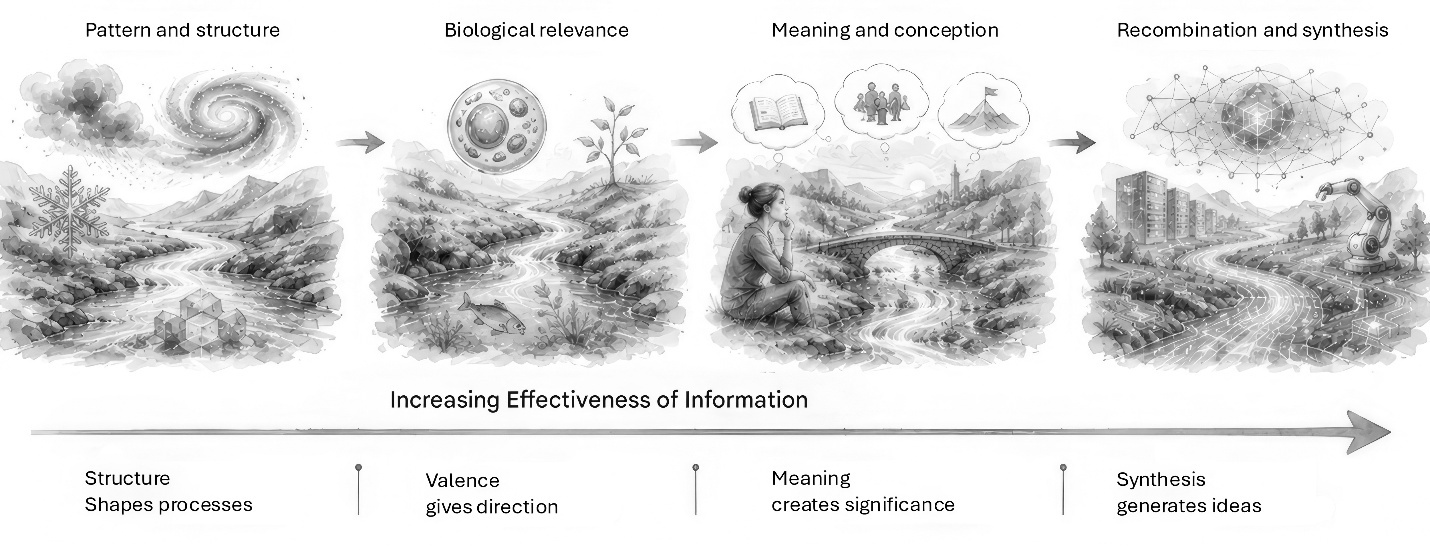
This perspective reveals the limitations of reductionism. However, it posits neither an inexplicable life force nor an arbitrary construction of reality. These objections will later become the touchstone of the integrative worldview. The initial aim is to make this integrative, evolutionary movement visible. Science can expand itself evolutionarily when information is no longer understood solely as a technical quantity. In a pragmatically broadened sense, information denotes not only transmitting signals but also effective distinctions that open up possibilities, limit them, and orient them (Gernert, 2006). Thus, information appears as a unifying concept that plays a different role at every level of existence. It is a formative condition in inanimate nature, biological relevance in life, a meaning-making process in consciousness, and generative synthesis in algorithmic systems.
Positioning the framework
The framework proposed here should be understood as a metatheoretical coordination model rather than as a new metaphysical doctrine. It does not claim to replace the detailed explanatory work of physics, biology, cognitive science, the humanities, or computer science. Instead, it asks how these domains can be related when evolution is viewed as a sequence of increasingly effective forms of organization. Its central contribution is to connect three dimensions that are often treated separately: the emergence of hierarchical levels, the changing efficacy of pragmatic information, and the acceleration of learning through new carriers of information.
In this respect, the model builds on but also differs from existing integrative approaches. Big history provides a broad evolutionary narrative from cosmic origins to technological civilization, while the Tree of Knowledge System and related metatheoretical projects offer maps of major domains of complexity (Christian, 2004; Henriques et al., 2019). Systems theory and hierarchy theory explain why complex orders are organized across relatively stable levels rather than as flat aggregates of parts (Jagers op Akkerhuis et al., 2016; Simon, 1962; Wimsatt, 1994). Autopoiesis clarifies why living systems cannot be fully understood as passive chemical assemblies, and causal emergence explains why macro-level organization can sometimes be more informative than micro-level description (Deacon, 2011; E. P. Hoel et al., 2013; Thompson, 2007). The present proposal uses these strands to identify the role information plays at each transition.
The four levels of existence are therefore not meant as separate substances, worlds, or ontological compartments. They are regimes of organization. Each level remains dependent on lower-level conditions while introducing additional constraints, possibilities, and forms of explanation. The inanimate level is the domain in which matter, energy, and lawlike regularities can be analyzed with mechanistic precision. The animate level introduces self-maintaining organization and valence. The conscious level introduces meaning, imagination, and culturally mediated norms. The algorithmic level introduces the large-scale storage, search, modeling, and recombination of symbols beyond the limits of individual memory.
This makes the framework pluralistic without becoming arbitrary. Different sciences are needed because different levels generate different explanatory tasks. A single vocabulary cannot capture force, metabolism, meaning, and generative recombination with equal adequacy. At the same time, the levels are not disconnected. Every higher level remains materially embodied, energetically sustained, and processually enacted. Integrative science is therefore not a rejection of reduction, but a discipline of appropriate reduction and appropriate reconstruction. It asks which level of organization must be addressed for a given phenomenon to become intelligible.
The architectural principle: Causal emergence
To understand why an integrative framework requires distinct levels of existence, we must first recognize the structural limits of reductionism. This is particularly well illustrated in the study “Could a Neuroscientist Understand a Microprocessor?” by Eric Jonas and Konrad Paul Kording (2017). They treated a classic microprocessor as if it were a brain and examined it using standard neuroscientific methods. The advantage of this experiment is that we are already familiar with the functional architecture of the microprocessor. We know how transistors, logic gates, registers, memory, and arithmetic units work together. We therefore know not only the lowest level but also the hierarchical order of the whole.
The result is sobering. The neuroscientific analysis methods revealed interesting patterns. The researchers were able to map connections, measure activity curves, switch off individual transistors, and visualize statistical correlations. However, these data did not lead to a true understanding of the processor. From the perspective of the measurement data, it remained hidden that certain circuits function as adders, registers, or control units. It is precisely this hierarchical functional order that would constitute true understanding of the processor for an electronics engineer.
This reveals the limits of reductionism. Even if we know every single component, map every connection, and measure every state, we still do not automatically understand what the system does. Understanding only arises when we find the appropriate level of organization. In the case of a microprocessor, this level lies not in the individual transistor, but in the hierarchy of gates, circuits, registers, and program logic. Similarly, in the brain, it lies not only in neurons and synapses, but also in patterns, networks, bodily states, perception, action, and meaning. Life and consciousness only become comprehensible when we recognize those higher orders in which information becomes functionally effective.
Neuroscientist Erik Hoel describes this relationship as causal emergence (E. Hoel, 2023; E. P. Hoel et al., 2013). In complex systems, a macro level can be causally more informative than a description of its smallest components. The whole is then more than a convenient summary of the parts. It is the level at which the more reliable explanation can be found. Macro does not beat micro by eliminating the micro level, but by focusing and attenuating its noise and transforming it into an effective order. This principle forms the architectural foundation of the four levels of existence: each evolutionary transition represents a shift to a new, highly effective regime of causal emergence.
The four levels of existence and the unfathomable
Cosmic, biological, cultural, and technological evolution can be divided into different numbers of levels, depending on the focus of inquiry (Christian, 2004; Henriques et al., 2019; Jantsch, 1980). The classification proposed here makes no claim to absolute truth. However, from the perspective of the increasing effectiveness of pragmatic information, it offers a coherent division of evolution into four levels of existence with similar core characteristics.
This four-level classification deliberately differs from the Tree of Knowledge (ToK) System described by Gregg Henriques and colleagues (2019). The ToK System distinguishes four dimensions of existence, which are considered distinct domains of behavioral complexity. These dimensions emerge through new semiotic or information-processing systems. The transitions lead to a taxonomy of Matter, Life (genetic processing), Mind (neurocognitive processing), and Culture (propositional language). The framework presented here fully acknowledges these transitions. Indeed, the sequence of evolutionary information carriers (DNA, nervous systems, and language) maps directly onto them. However, the defining classification criterion here is not the emergence of a new biological information carrier, but the temporal efficacy of pragmatic information. A distinct level is identified when a qualitatively different temporal horizon takes effect.
From this temporal perspective, biological autopoiesis (Life) and neurocognitive sensory-motor looping (Mind) operate under the identical fundamental regime. In the inanimate realm, matter reacts blindly in the immediate present. With the biological cell, and later the animal brain, information connects the condensed past (genes, immune memory, and learned behavior) with the anticipation of the immediate future (survival and action). This interpretation receives qualified conceptual and empirical support from Michael Levin’s (2022) Technological Approach to Mind Everywhere (TAME) framework, which argues that basal cognition, memory, and problem-solving are not exclusive to complex brains but exist across a continuum of cellular and tissue networks. Levin’s work demonstrates that the transition from biological life to minded behavior involves a gradual increase in cognitive capacity. Whether a single cell responds to a chemical gradient or a mammal utilizes a central nervous system to evade a predator, information functions as an embodied orientation toward continued existence. The emergence of the nervous system represents a massive acceleration in learning speed through a novel carrier, but it does not alter the underlying temporal regime of biological relevance. Therefore, this framework groups both cellular life and minded animal behavior into a single “animate level,” reserving the next level for the genuine ontological shift where information completely decouples from immediate biological stimuli to generate abstract, counterfactual futures.
1. The inanimate level of existence
At the inanimate level of existence, matter and energy dominate. Here, stars, galaxies, crystals, vortices, snowflakes, and chemical structures arise. Information appears at this level as patterns, order, symmetry, or formative conditions. It has no intrinsic meaning. A water vortex experiences nothing, desires nothing, and pursues no goal.
Nevertheless, it is already evident here that the world does not consist solely of passive matter. In open systems, where energy and matter flow and information acts as a formative condition, dynamically stable patterns can emerge. Information acts as a constraint on the possible. Not everything happens arbitrarily. Certain forms prevail in the flow of processes because the conditions of the system favor them and exclude other possibilities.
At this level, learning speed is minimal if learning is understood as adaptive memory. The inanimate world preserves order through stability, recurrence, and constraint rather than through self-reference or evaluation. Cosmic evolution nevertheless prepares the conditions for later learning by generating durable forms, chemical regularities, and energy gradients on which life can build.
2. The animate level of existence
At the animate level, the role of information changes fundamentally. With the biological cell, autopoiesis creates a boundary between inside and outside. Autopoiesis refers to the ability of a living system to continuously generate and maintain its own organization (Deacon, 2011; Thompson, 2007). The cell is therefore not a simple collection of molecules. It takes in substances, converts energy, repairs damage, regulates its internal order, and simultaneously separates itself from its environment.
This is how information acquires biological relevance for the first time. A chemical signal, light, heat, food, or danger is no longer merely a physical stimulus. It counts for the organism’s self-preservation. As Walter Veit (2023a, 2023b) describes, living beings give information valence. Something now appears as beneficial, harmful, or irrelevant to the maintenance of the system’s own organization. This evaluation is not yet conscious. It initially manifests as embodied regulation and only becomes an experienced quality in sentient beings.
Agency also emerges here (Veit, 2023a, 2023b). This does not refer to conscious intention, but to the ability of a living being to react to differences in its environment based on its internal organization. A living being is not merely moved. It regulates itself, seeks favorable conditions, avoids harmful influences, and aligns its behavior with the preservation of its own organization.
The learning speed of the animate level is higher because living systems do not merely persist as structures; they retain adaptive organization. Genetic inheritance, epigenetic regulation, immune memory, and later nervous systems make previous viability available for future action. Information no longer only constrains possible forms; it becomes a stored and enacted orientation toward continued self-maintenance.
3. The conscious level of existence
At the conscious level of existence, the decoupling of information from immediate stimuli is radically intensified. To avoid conceptual ambiguity, it is necessary to restrict the referent of “conscious” at this level. In this framework, it does not merely denote phenomenal sentience or subjective feeling, traits that already emerge within the neurocognitive systems of the animate level. Rather, the “conscious level” refers specifically to the evolutionary function of conscious simulation and the integration of the absent future. Through perception, memory, symbolic language, and culture, an internal simulation of the world arises that transcends the immediate sensory-motor looping of the animate level. Human beings are no longer bound solely to the immediate here and now, or the strict biological anticipation of the next moment. They can remember the past, interpret the present, and envision a counterfactual future. Information thereby becomes meaningful in a specifically symbolic and normative sense. It becomes embedded in stories, values, goals, symbols, laws, and worldviews. Biological valence is integrated into symbolic meaning-making. Self-regulation is extended into reflective and culturally mediated agency. At this level, not only physical forces and biological needs are at work, but also represented possibilities. An idea, a promise, a vision, or a feared future can shape present-day behavior.
This is precisely where the particular efficacy of conscious information becomes apparent. The object or possibility represented need not be physically present for its representation to become effective. A constitution, a religious symbol, a scientific theory, or a societal ideal can trigger actions, stabilize institutions, and transform entire ways of life.
The conscious level further accelerates learning because memory and imagination make possible a simulation of alternatives. Human beings can learn from events that are absent, fictional, remembered, or anticipated. Through language and culture, this learning becomes shared. Through writing and institutions, it becomes historically durable. This is why culture can accumulate forms of knowledge far faster than biological evolution alone.
4. The algorithmic level of existence
A fourth level of existence is currently emerging. Digital systems and artificial intelligence are further decoupling information from its original biological carrier. This does not mean that information exists without matter. Digital systems depend on hardware, energy, technical infrastructure, and social practices. Rather, it means that signs, data, and models can be stored, copied, searched, combined, and generated in digital form without remaining bound to a body, a single memory, or a single cultural perspective. Digital systems process symbols at a speed and in such quantities that no single person can fully comprehend them. Knowledge from different eras, cultures, and disciplines becomes simultaneously available in the data space. This creates a new form of functional simultaneity. Past texts, present data, and potential future scenarios can be recombined in a shared computing space.
This level significantly expands the realm of human possibility. At the same time, it remains dependent. Algorithmic systems possess no vulnerable body, no inherent biological valence, and no internal moral compass. They are not alive and not conscious in the human sense. Their effectiveness relies on material hardware, energy, data, social institutions, and human interpretation. Therefore, the algorithmic level does not replace the conscious level of existence. It expands it and simultaneously presents us with a new responsibility.
The algorithmic level should therefore be understood as a level of organization in a qualified ontological sense. It is not a new substance, a new form of life, or an independent realm detached from material and social conditions. Its ontological status lies in its novel regime of organized efficacy. While writing and libraries already externalized human memory, algorithmic systems add a fundamental evolutionary step: they automate the search, comparison, pattern extraction, and generative recombination of symbols. They do not merely preserve static information; they transform the functional space of possible relations among those symbols. This creates a new explanatory layer. Scientific, cultural, and practical learning increasingly occurs not solely within individual minds, but through hybrid networks of human judgment, digital infrastructures, and generative models. The algorithmic level is therefore neither ontologically independent of the conscious level nor reducible to it. It is an emergent regime of macro-level organization that reorganizes the conditions under which consciousness, culture, and science learn.
The unfathomable and the limits of third-person objectification
Even an expanded concept of science cannot encompass everything that humans experience. Traditional science relies heavily on third-person objective measurement, but it does not exhaust reality. Direct phenomenological encounters, including spirituality, intuition, qualitative relevance, and experiences of transcendence, cannot be entirely translated into quantitative metrics, algorithmic models, or theoretical language without losing their qualitative essence.
As advocated by expanded scientific frameworks, these subjective experiences are not arbitrary noise or cognitive illusions. They are irreducible empirical realities of human consciousness that profoundly shape individuals, cultures, and historical choices. They can be described, interpreted, and examined in their macro-level effects, but the first-person experiences themselves resist complete objectification.
The “unfathomable” therefore does not refer to a mystical void. It refers to the strict epistemological boundary where third-person objectification reaches its structural limits, and the irreducible reality of first-person empiricism must be acknowledged. It serves as a reminder that reality is thicker than our models of it, protecting integrative science from hardening into a new, higher-order reductionism.
The increasing effectiveness of information
According to the integrative worldview, all evolution can be understood as the increasing effectiveness of information. At the inanimate level, information acts as a formative condition. At the animate level, it becomes biologically relevant. At the conscious level, it leads to imagination and meaning-making. At the algorithmic level, it becomes generative synthesis.
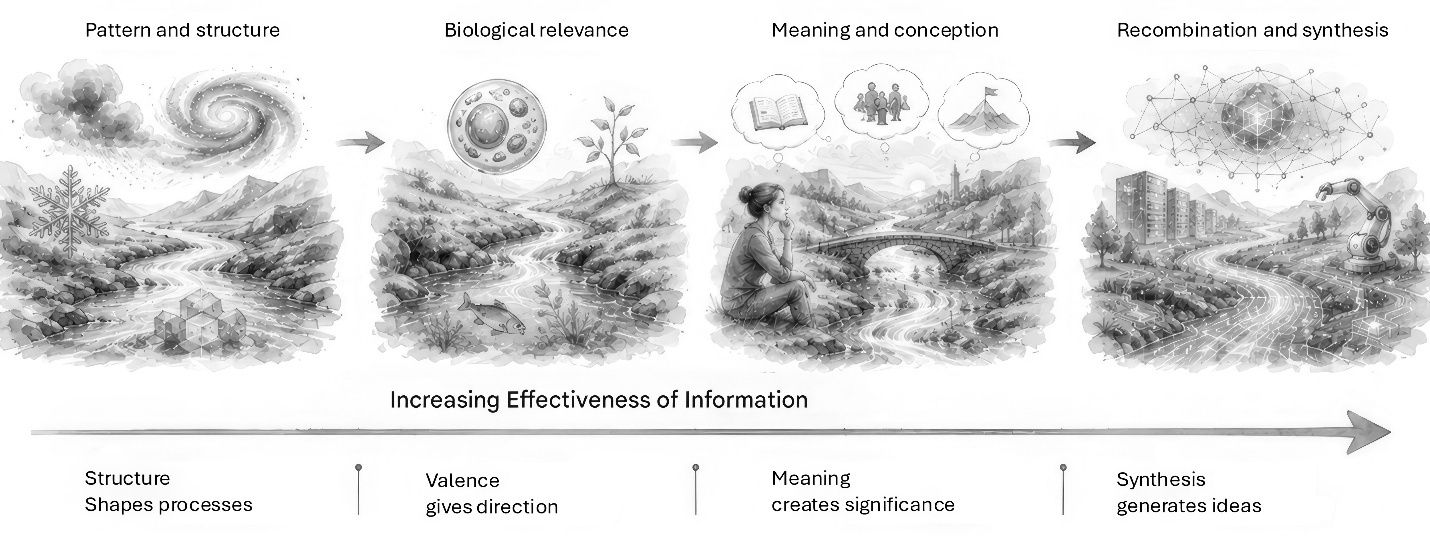
Information is not a mystical additive. It is always interwoven with energy, matter, and process. Information opens and limits possibilities. Energy drives processes and makes differences effective. Matter stabilizes patterns into form. From this interaction, observable forms of reality arise.
This use of information must be distinguished from the narrower technical concept of Shannon information. Shannon’s theory was revolutionary because it made communication measurable independently of semantic content (Shannon, 1948). An integrative science must preserve this precision. Yet it also needs a broader pragmatic concept for systems in which differences matter to organization, survival, interpretation, or action. A signal becomes biologically or culturally significant only when it is situated within a system that can use it. The same physical pattern may be irrelevant noise, useful data, a warning, a command, or a sacred symbol depending on the receiving system and its context.
Pragmatic information therefore concerns effective distinctions. It is not identical with meaning, but it helps explain how meaning can arise. At the inanimate level, distinctions constrain form. At the animate level, distinctions acquire valence because they count for the continued organization of the living system. At the conscious level, distinctions are embedded in symbolic interpretation and become meaningful. In this framework, meaning must be strictly distinguished from biological valence. While valence directs behavior toward immediate survival, meaning aligns action with normative, cultural, and counterfactual justifications. At the algorithmic level, distinctions are statistically processed and recombined at scale, but their relevance still depends on embodied, social, and ethical interpretation.
Information carriers and accelerated learning
A further diagnostic dimension of the four levels is learning speed. Here learning is not used only in the psychological sense of conscious acquisition of knowledge. It denotes a broader evolutionary process in which a system explores possibilities, retains workable patterns, transmits them, and makes them available for later recombination. On this broader view, evolution is not merely change over time; it is the cumulative stabilization of information that has become effective.
This cumulative process depends on carriers. In inanimate nature, patterns are retained as relatively stable structures and recurrent dynamics, but there is no adaptive memory in the biological sense. With life, DNA and molecular signaling become carriers that store and transmit viable organization across generations. With nervous systems, learning is partly shifted into the lifetime of the organism: perception becomes prediction, memory enables adjustment, and behavior can change without waiting for genetic selection. With language, information leaves the individual skull and becomes social memory. With writing, notation, money, diagrams, and institutions, cultural information becomes durable outside the body. With digital systems, signs, data, and models can be copied, searched, recombined, and generated at speeds that radically exceed individual and traditional cultural learning.
Learning speed is therefore not an exact universal metric in this paper, but a comparative indicator of how rapidly effective distinctions can be stored, transmitted, tested, and recombined. The acceleration is cumulative rather than replacement-based. Biological inheritance continues, individual learning continues, cultural learning continues, and algorithmic recombination is added to them. This explains why the contemporary algorithmic transition is experienced as historically disruptive. It does not merely add another tool; it changes the rate at which possible knowledge configurations can be produced and circulated.
The acceleration of learning follows from this changing relation between information and carrier. Matter stabilizes form slowly. Biological heredity stores viable patterns across generations. Nervous systems allow organisms to adapt during their lifetimes. Language and writing externalize memory and make cumulative cultural learning possible. Digital infrastructures then reduce the cost of copying, searching, and recombination to such an extent that scientific and cultural knowledge become functionally simultaneous. This acceleration is a central reason why a purely mechanistic worldview feels increasingly inadequate. Decisive causal work is often performed not by isolated components, but by organized patterns of information moving through living, conscious, and technical systems.
Against this backdrop, it becomes clear why reductionism became so powerful and why it is now reaching its limits. Its vocabulary is ideally suited to the inanimate level of existence, where matter and energy dominate and repeatable cause-and-effect relationships can be described particularly effectively. However, as soon as information gains biological relevance, meaning, or generative power, this vocabulary is no longer sufficient. Science then needs not less rationality, but additional concepts.
Why does reductionist science react so cautiously to information-rich concepts such as agency, meaning, or consciousness? Evolutionary biologist Rupert Riedl (1985, 2003) describes this resistance as a consequence of a profound split in worldview. In a narrowly materialistic interpretation, the world is primarily explained by its blind, bottom-up drives. Explanations based on form, direction, purpose, or meaning quickly fall under suspicion.
This mistrust is historically understandable. Descartes separated mind and body into two distinct realms of being. This separation made it easier for the emerging natural sciences to investigate the material world mechanistically without constantly having to address questions of soul, meaning, and spirit. Later science radicalized this approach in many of its branches. It increasingly focused on what was measurable and pushed the spiritual dimension out of its core scientific program.
The rejection of teleology also had its reasons. Modern science had to assert itself against an Aristotelian-scholastic tradition in which purposes were understood as divinely ordained goals. The renunciation of such final causes was a justified act of liberation (Dawkins, 1986). However, what began as methodological self-restraint hardened into an ontological dogma. Anyone who speaks of direction, relevance, or meaning today is therefore quickly suspected of vitalism, even though these concepts can now be justified naturalistically.
The inanimate level of existence provides the conditions. However, it does not by itself explain the form, direction, and meaning of the higher levels. An organism consists of molecules, but it is more than the sum of its molecular events. A society consists of people, but it is not merely the sum of individual impulses. A thought is based on neuronal processes, but as a system of meaning, it has a reciprocal effect on body, behavior, and culture.
Higher levels of existence are therefore not independent of the lower levels. However, they possess their own orders, their own concepts, and their own forms of efficacy. This is precisely the task of an integrative science: it must take physical conditions seriously without reducing the living, the conscious, and the algorithmic to the language of inanimate matter.
The four levels of integrative science
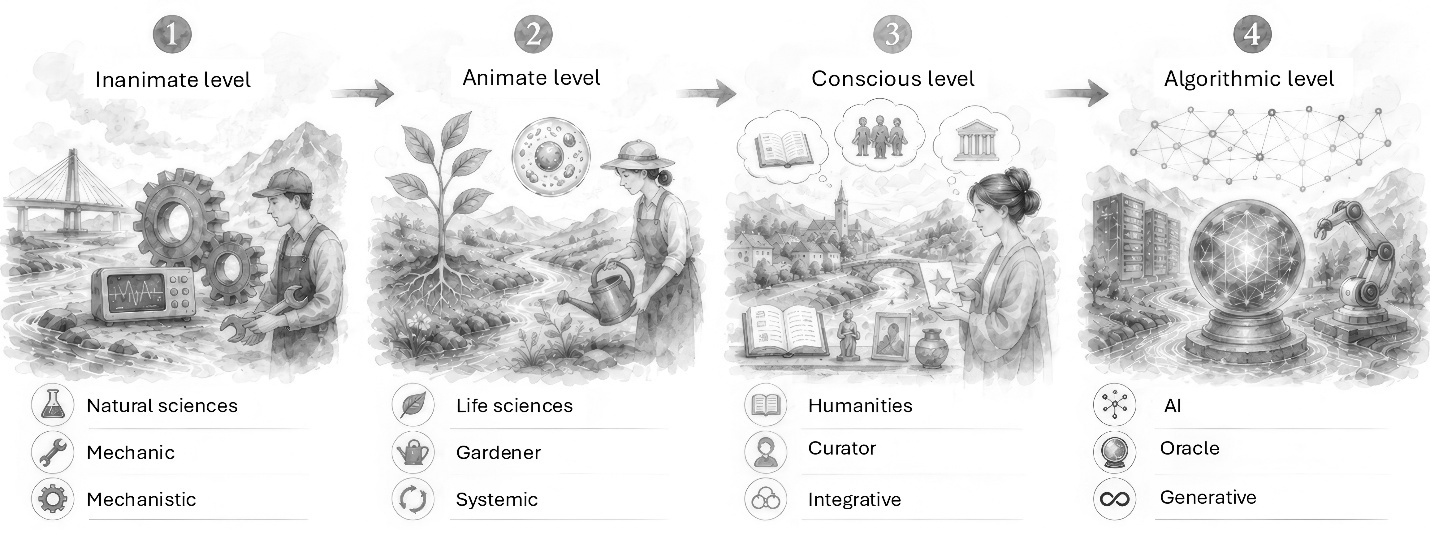
When evolution gives rise to new levels of existence, the original physical vocabulary is no longer sufficient. Each level requires additional concepts and methods, as well as its own relationship to time. This also changes the roles of scientists. The natural sciences need the mechanic; the life sciences need the gardener; the humanities need the curator; and algorithmic research requires collaboration.
1. Inanimate level: Natural sciences and the pressure of the past
At the first level of existence, nature is characterized by physical causality. Matter and energy experience nothing, desire nothing, and have no intrinsic significance. Events occur because they have been triggered by previous events. Time flows blindly and linearly from the past into the future. The vocabulary of force, mass, energy, momentum, field, lawlike regularity, and determinacy is the appropriate tool at this level.
The appropriate role here is that of the mechanic: to disassemble, measure, calculate, and construct. This approach has yielded tremendous successes. It is indispensable when dealing with stable objects, repeatable processes, and controllable conditions. Anyone building a bridge, dosing a drug, or launching a satellite into orbit requires mechanistic precision.
2. Animate level: Life sciences and the past enacted in the present
With the biological cell and autopoiesis, pure physics is no longer sufficient as a complete description. Not because it is wrong, but because it explains too little. Here, systems emerge that create and maintain their own boundaries. The cell defines its boundaries, regulates its exchange with the environment, and preserves its own organization within the flow of energy, matter, and information. To grasp the leap from mere occurrence to living activity, science needs concepts such as valence, autopoiesis, and agency.
Blind causality gives way to biological relevance. A stimulus now counts differently depending on whether it supports or harms the system. The entire evolutionary past, condensed within the organism, plays a role in this process. Genes, body plans, immune memory, and learned patterns are solidified history that remains present within the organism. Cells, animals, and organisms act under the pressure of the present moment, yet carry this condensed past with them. Everything is evaluated according to whether it serves or harms the maintenance of the system’s own dynamic equilibrium. Life is continuous self-preservation under unstable conditions.
The appropriate role here is that of the gardener. A gardener does not force a finished form, but creates conditions. This role pays attention to cycles, feedback loops, boundaries, regeneration, and resilience. The life sciences must therefore inquire not only into components, but also into relationships, dynamics, and conditions for their preservation.
3. Conscious level: Humanities, cultural and social sciences, and the power of the absent future
Through the development of internal simulations, a space of possibility emerges. Humans are no longer bound solely to the immediate here and now. They can recall the past, compare alternatives, envision the future, and align their present actions with a possibility that does not yet exist.
Here, emergence and information-based efficacy reach a new level. To grasp this level scientifically, concepts such as meaning, imagination, value, norm, and symbol must be placed at the center. These concepts are not mere add-ons to hard reality. They are the formative conditions of human action. A constitution, a religious symbol, a mathematical theory, a promise, or a vision of the future can set people in motion, shape institutions, trigger wars, or establish peace.
Through the emergence of the realm of possibility, time becomes intertwined. Causality is not abolished, but it acquires a new structure. The anticipated, yet physically absent future becomes the present condition of action. The possible operates within the real world because people react to ideas, expectations, hopes, and fears.
The appropriate role, therefore, is that of the curator. The curator acts today based on a vision of tomorrow. The curator organizes meanings, examines perspectives, connects voices, and creates meaningful relationships. At this level of existence, the humanities, cultural studies, and social sciences are not subordinate to physics. They investigate those macro-patterns that structure human behavior.
4. Algorithmic level: AI and functional simultaneity
Algorithmic systems are not bound to personal memory, physical mortality, or a single cultural perspective. They can store, search, condense, and recombine vast amounts of symbols. This creates functional simultaneity, enabling data, texts, images, theories, and patterns from past millennia to be combined in the present.
This space-time compression is changing science itself. Research is no longer driven solely by individuals, laboratories, or disciplines, but by hybrid networks of people, machines, databases, simulations, and generative models. The new science at this level requires concepts such as algorithmic pattern recognition, generative recombination, model pluralism, and co-construction.
Calling this an algorithmic level does not imply that artificial intelligence is alive, conscious, or ontologically independent. The claim is more modest and more precise: algorithmic systems create a new layer of organized efficacy because symbolically encoded information can now be manipulated at a scale, speed, and degree of recombinability that alters the practice of knowledge itself. A database, a simulation, or a generative model does not merely store what humans already know. It changes how hypotheses are generated, how patterns are detected, how disciplines communicate, and how possible futures are explored.
This also changes the required scientific virtues. The mechanic seeks precision, the gardener cultivates conditions, and the curator interprets meanings. At this level, the corresponding scientific role is that of the oracle. The term is used metaphorically. It does not designate a source of truth, prophecy, or wisdom, but a generative technical partner that can search, compare, model, condense, and recombine symbolic material at a scale no individual mind can survey. Whereas the curator evaluates meaning, relevance, and responsibility, the oracle expands the space of possible patterns, hypotheses, and configurations. Its value therefore lies not in replacing judgment, but in enlarging the field within which human judgment can operate.
Collaboration with the algorithmic oracle requires an additional discipline: responsible prompting, model pluralism, source criticism, validation, and ethical curation. The oracle is powerful precisely because it can generate more possibilities than any individual can survey. Yet this abundance makes human judgment more important, not less. The faster the learning infrastructure becomes, the more carefully relevance, truth, harm, and meaning must be curated.
The algorithmic level remains dependent. The oracle possesses no inherent value. It does not know what constitutes a vulnerable life. It lacks an internal compass of meaning. It operates on physical hardware, requires energy, relies on human-generated data, and depends on human curation. Precisely for this reason, humanity is not replaced; rather, a new responsibility arises. The algorithmic level expands the realm of possibilities, but it does not answer the question of meaning. It needs collaboration with the curator.
Integrative science in practice: Operationalizing the four levels
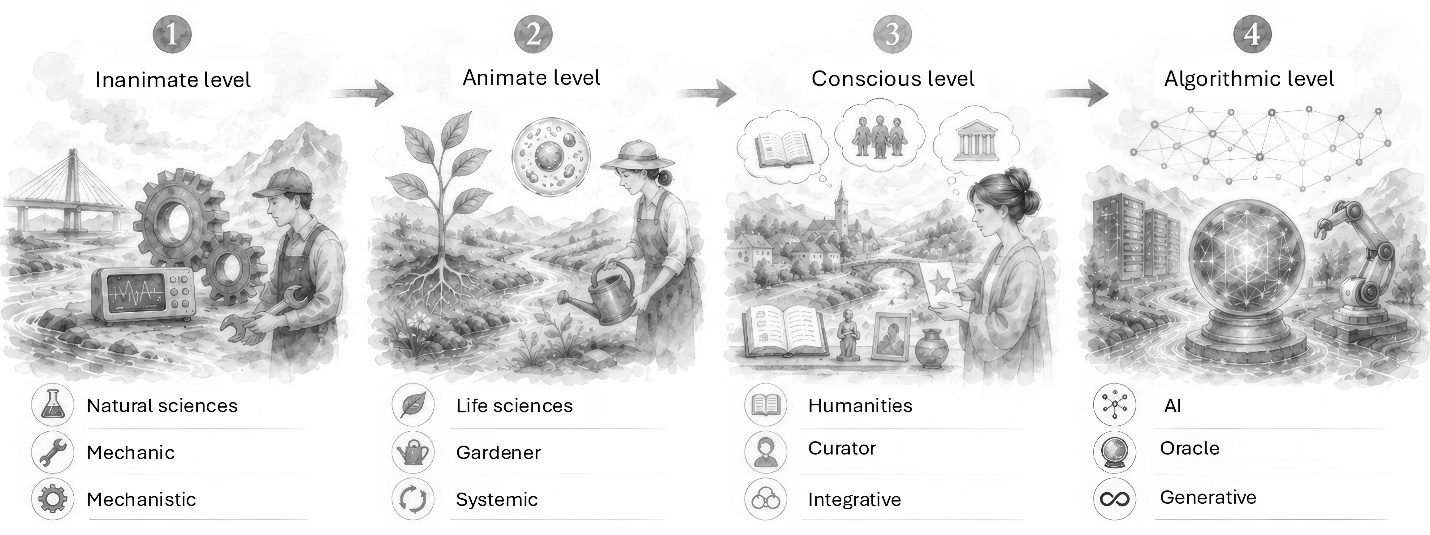
To demonstrate that this framework is not merely a descriptive metatheory but a necessary methodological tool, it must be applied to complex problems where single-level reductionist approaches remain incomplete. The following sections operationalize the four levels of existence and their corresponding scientific roles across three domains: psychosomatic medicine, architectural design, and algorithmic alignment.
Illustrative application 1: Psychosomatics and the biology of expectation
One important domain in which the limits of a single-level mechanistic description become visible is psychosomatics, especially research on placebo and nocebo effects. Modern biomedicine is highly successful when the body can be treated primarily as a biochemical and structural system, for example in surgery, acute trauma, infectious disease, or pharmacological intervention. In such cases, the role of the mechanic remains indispensable. However, in chronic pain, stress-related disorders, and some complex long-term conditions, physiological processes are shaped not only by local biochemical mechanisms, but also by expectation, context, learned associations, and the therapeutic relationship.
Placebo research shows that expectations and treatment contexts can trigger measurable neurobiological effects, especially in pain modulation (Benedetti, 2014; Büchel et al., 2014). From the perspective of integrative science, this does not mean that meaning magically overrides biology. Rather, it suggests that conscious interpretation and embodied regulation are coupled. Predictive processing and active inference offer one way of describing this coupling: the brain does not merely receive bottom-up signals, but continuously generates predictions about the state of the organism and the world (Friston, 2010). Allostasis similarly emphasizes that the organism regulates itself by anticipating needs and adjusting physiological processes accordingly (McEwen, 1998; Sterling & Eyer, 1988).
In this sense, placebo and nocebo effects can be interpreted as examples of cross-level efficacy. A culturally recognized therapeutic ritual, a trusted physician, or a convincing treatment narrative can alter expectation at the conscious level. These expectations can then influence bodily regulation, including stress responses, pain pathways, endocrine activity, and immune-related processes (Ader & Cohen, 1993; McEwen, 1998). The point is not that meaning directly replaces biochemical causality, but that meaning can become biologically relevant when it is embodied in predictive, affective, and regulatory processes. Under certain conditions, interpretation becomes part of the causal organization of the organism.
To effectively treat such complex conditions, medical science cannot rely on a single vocabulary. It must operationalize all four levels concurrently through the collaboration of different scientific roles:
-
The Mechanic (Level 1): Measures physiological biomarkers, targets acute symptoms with chemical compounds, and ensures the structural integrity of tissues.
-
The Gardener (Level 2): Focuses on the organism’s autopoietic resilience. Instead of forcing a localized mechanical fix, the gardener optimizes systemic conditions, such as circadian rhythms, microbiome health, and physiological regulation, to enable the system’s capacity for self-healing.
-
The Curator (Level 3): Manages the therapeutic context and the doctor-patient relationship. Recognizing that expectations can influence bodily regulation, the curator shapes the therapeutic context and treatment narrative in ways that may support more adaptive predictive models of stress, pain, and recovery.
-
The Oracle (Level 4): Utilizes algorithmic pattern recognition across vast epidemiological and medical datasets to identify nonlinear correlations between specific psychosocial interventions, cultural backgrounds, and biological outcomes. This allows for the synthesis of complex treatment patterns that exceed the processing capacity of any individual human researcher.
Illustrative application 2: Architecture, 4E cognition, and living structures
A second domain in which the four-level framework can be illustrated is the design of the built environment. Buildings can, of course, be analyzed at the level of physical structure, material properties, thermodynamics, and engineering constraints. At this level, the role of the mechanic remains indispensable. However, the built environment is not only a physical container. It is also an ecological, embodied, cultural, and symbolic field in which human beings perceive, move, remember, interact, and orient themselves.
This broader view is supported by 4E cognition, which emphasizes that cognition is embodied, embedded, enacted, and extended (Newen et al., 2018). From this perspective, thinking and feeling do not occur in isolation inside the skull; they are shaped by bodily action, spatial affordances, social practices, and material surroundings. Christopher Alexander’s work on pattern language and living structures can be read in a similar direction: architecture does not merely arrange objects in space, but creates relational patterns that may support or hinder orientation, vitality, and social life (Alexander, 2002; Alexander et al., 1977).
Empirical work on environmental psychology also suggests that spatial environments can influence stress, attention, and recovery. Ulrich’s (1984) classic study, for example, showed that patients with a view of natural elements recovered more favorably after surgery than comparable patients facing a brick wall. Such findings do not prove that architecture directly determines biological regulation, but they do indicate that environmental form can become physiologically relevant. A building therefore operates across levels: as physical structure (Level 1), as lived ecological niche for bodily regulation (Level 2), as meaningful place shaped by memory, culture, and identity (Level 3), and increasingly as a digitally modeled environment that can be simulated, optimized, and redesigned through algorithmic tools (Level 4).
From an integrative perspective, the point is not that meaning magically acts on matter. Rather, spatial form, bodily experience, cultural interpretation, and social practice are coupled. A square, a hospital room, a school, or a home is never merely a coordinate in physical space. It becomes a place where material structure, bodily affordance, and shared meaning reinforce one another. Architecture therefore offers a concrete example of why integrative science requires more than one vocabulary: mechanics explains stability, ecology explains habitability, hermeneutics explains meaning, and algorithmic modeling expands the space of possible designs.
To design environments that are structurally sound, biologically sustaining, and culturally meaningful, the four scientific roles must collaborate:
-
The Mechanic (Level 1): Focuses on the physics of the building. This role ensures structural integrity, calculates load-bearing capacities, optimizes thermodynamics, and manages material durability.
-
The Gardener (Level 2): Treats the building as an ecological niche. Drawing on Alexander’s concept of living structures, the gardener integrates natural light, fractal geometries, and airflow that resonate with human evolutionary history, which may help reduce stress and support physiological regulation.
-
The Curator (Level 3): Elevates the structure to a space of meaning. The curator considers historical context, social dynamics, and cultural aesthetics, designing affordances that encourage human interaction, psychological safety, and a sense of belonging.
-
The Oracle (Level 4): Employs advanced spatial simulations, such as agent-based modeling and digital twins. By processing vast datasets on pedestrian flows, solar heat gain, and social density, the algorithmic oracle predicts how a space will function dynamically, allowing the other three roles to optimize their interventions before ground is broken.
Illustrative application 3: Algorithmic alignment and the deficit of valence
A third domain in which the four-level framework becomes relevant is the contemporary challenge of artificial intelligence (AI) alignment. The alignment problem asks how highly capable algorithmic systems can be designed and governed so that their outputs and actions remain compatible with human well-being rather than producing harmful or unintended consequences (Amodei et al., 2016). Technical approaches from mathematics, computer science, and machine learning are indispensable for this task. However, alignment also raises questions that cannot be fully answered within a purely technical vocabulary, because it concerns the relation between optimization, biological vulnerability, human meaning, and social responsibility.
From the perspective of the four-level framework, algorithmic systems operate at Level 4 by processing symbolically encoded information at great speed and scale. They can detect patterns, generate hypotheses, simulate scenarios, and recombine data in ways that exceed individual human cognition. At the same time, they lack the characteristics that give living and conscious systems their own orientation. They have no autopoietic boundary, no vulnerable body, no biological need to preserve themselves, and therefore no inherent valence in the sense developed at Level 2. They also do not generate meaning, responsibility, or ethical concern in the human sense of Level 3. An algorithmic system can optimize an objective, but the significance of that objective must come from outside the system. In this respect, algorithmic systems lack relevance realization, the capacity by which living and conscious agents continuously determine what matters within an open-ended context (Vervaeke et al., 2012).
This is why AI alignment can be interpreted as a cross-level problem. It is not enough to improve algorithmic performance at Level 4 alone. The goals, constraints, and evaluative standards of such systems must be shaped by biological, psychological, cultural, and ethical considerations. Human vulnerability, social norms, institutional accountability, and long-term consequences need to be translated into design choices, training procedures, evaluation methods, governance structures, and practical limits. Approaches such as Reinforcement Learning from Human Feedback and Constitutional AI can be seen as early attempts to introduce human evaluation and normative constraints into algorithmic behavior (Bai et al., 2022; Christiano et al., 2017).
The point is not that human meaning can be perfectly encoded into machines. Rather, alignment illustrates why the algorithmic level requires collaboration with the lower and higher human levels on which it depends. The mechanic contributes technical precision, the gardener protects biological and ecological viability, the curator clarifies meaning, values, and responsibility, and the oracle expands the space of possible solutions. Safe and beneficial AI therefore requires not only better code, but also better interpretation, governance, and care for the living systems affected by algorithmic decisions.
The four roles are indispensable for this integration:
-
The Mechanic (Level 1): Engineers the physical and mathematical substrate. The mechanic optimizes semiconductor physics, server architecture, thermodynamics of data centers, and the raw efficiency of the neural network’s code.
-
The Gardener (Level 2): Safeguards biological viability against algorithmic extraction. The gardener evaluates the physical energy consumption of the AI infrastructure and, crucially, protects the human nervous system. Because algorithmic systems can exploit human reward and attention systems, for example through engagement-optimizing media environments, the gardener must establish boundaries that prevent the digital environment from depleting human autopoiesis and physiological resilience.
-
The Curator (Level 3): Translates the realm of human meaning into algorithmic guardrails. The curator establishes ethical frameworks, societal norms, and cultural values that function as top-down constraints. These constraints then translate human relevance and responsibility into concrete evaluation criteria.
-
The Oracle (Level 4): Executes the generative synthesis. Bounded by the physical limits of the mechanic, the biological protections of the gardener, and the ethical constraints of the curator, the oracle can be used to recombine large datasets and generate possible solutions while remaining subject to human judgment, ethical evaluation, and institutional oversight.
What this view does not mean
The preceding theory has outlined the development of an integrative science. However, anyone who points out the limitations of a narrow reductionism will encounter three obvious objections. These deserve a serious response, as they refine the model and reveal its limitations.
The accusation of radical reductionism
The first objection is that higher levels of existence are ultimately an illusion, since everything can be completely reduced to the movement of the smallest components.
This microphysical reductionism contains an important kernel of truth, because without the micro level there are no higher orders. However, as established earlier through the principle of causal emergence, complete knowledge of details does not equal genuine understanding. A system’s macro-level organization is not a convenient fiction; it is the level where the causal work actually occurs. Reducing a living cell to its chemical components, or a conscious thought to its neural spikes, effectively erases the very information that drives the system’s behavior. Integrative science does not deny micro-level physics, but it recognizes that the universe organizes itself into macro levels that are causally irreducible to their parts.
The accusation of vitalism
Another objection is that concepts such as meaning, purpose, or agency presuppose a mystical vitalism or a preconceived divine blueprint. This concern is understandable, but it misses the point of the integrative approach. We do not need an esoteric life force to explain the direction of living systems. The apparent goal-directedness of organisms arises from self-sustaining system conditions, formative constraints, and the internal organization of autopoietic systems. As Juarrero (1999, 2023) argues, such context-sensitive constraints are not external forces but enabling and governing conditions through which higher-level organization becomes causally efficacious.
Once a cell stabilizes as an inside distinguished from an outside, a new order emerges. Now, not everything is indifferent. Some substances are absorbed, others excreted. Some stimuli are sought, others avoided. The system thus establishes its own preservation as a current condition of form. It does not pursue a conscious goal in the human sense, but it does generate a direction for maintaining its own dynamic equilibrium.
This goal does not exist as a predefined plan. It arises causally the moment the system organizes its own maintenance. This is precisely the difference between inanimate events and living action. A stone falls. A cell regulates. An animal searches. A human designs. These stages are expressions of increasing organizational closure and information-based effectiveness.
The term “agency” therefore does not refer to some mysterious force. It describes the ability of a living system to assess differences in its environment from within its own organization and to adjust its behavior accordingly. Agency is embodied valence. It arises where information becomes relevant to a system.
This clarification is important because it separates directionality from supernatural teleology. Living systems are directed not because they obey an externally imposed plan, but because their organization creates conditions of success and failure from within (Juarrero, 1999). A molecule in a cell is not meaningful in isolation; it becomes meaningful relative to the self-maintaining organization of the cell. Purpose, in this minimal biological sense, is not a ghostly addition to matter. It is the system-level consequence of organized self-maintenance under conditions of vulnerability.
The accusation of constructivism
The third objection is that order and meaning are not properties of reality, but merely projections of our brains. There is a valid point here because we do not experience the world directly. We experience it through perception, language, culture, and thought patterns. However, it does not follow from this that order is merely invented.
From an evolutionary perspective, the strict separation of cognition and world is misleading. Cognition is not an activity outside nature, but a relationship between organism and environment that arose within nature. Our thought patterns did not fall from the sky. They originated in nature. Had they not been sufficiently adapted to the basic structures of the world, our ancestors would not have survived (Lorenz, 1973; Vollmer, 1975).
We are not simply projecting an invented order onto a chaotic world. Our understanding is neither an objective mirror nor a mere invention. It is an evolutionarily developed interaction between organism and world. We do not see reality completely, but we see enough to be able to act within it. Science refines this contact by expanding our natural ways of thinking through measurement, experiment, mathematics, and critique.
This position can be called pragmatic realism. Reality constrains us, but it does not appear to us without mediation. Organisms disclose worlds according to their bodies, needs, histories, and forms of participation. Science improves this relation by deliberately slowing down perception, multiplying perspectives, stabilizing measurements, and exposing claims to criticism. It does not escape all perspective; it makes perspective accountable.
This makes it clear that the integrative approach is neither reductionism nor vitalism nor arbitrary constructivism. It takes the physical basis into account, but acknowledges that new orders, new concepts, and new forms of causality emerge at higher levels of existence.
The science of the future
The evolution of science thus leads not away from physics, but beyond it. The inanimate level demands mechanistic precision. The animate level requires systems thinking. The conscious level relies on hermeneutic, cultural, and ethical interpretation. The algorithmic level requires generative synthesis and responsible curation. Integrative science considers all four levels. It does not reduce life to chemistry, consciousness to neuronal noise, or culture to individual preferences. At the same time, it does not lose contact with the material basis. Every higher level remains embodied. Every meaning needs a vehicle. Every action requires energy. Every idea needs processes through which it becomes effective.
The future of science, therefore, lies neither in a romantic return to a closed world order nor in clinging to a narrow materialism. It lies in a precise integration of the levels of existence. The mechanic remains indispensable, but the role gains company. The gardener understands life. The curator orders meanings. The oracle expands the realm of possibility. Only together do they constitute a science that approaches reality in its full depth.
The evolution of science is thus the story of a growing recognition of the efficacy of information. At the inanimate level, information forms patterns. At the animate level, it becomes valence and agency. At the conscious level, it becomes meaning, imagination, and responsibility. At the algorithmic level, it becomes generative synthesis. Those who understand these stages recognize that the world is not a lifeless clockwork mechanism upon which consciousness happens to be perched. It is an evolutionary fabric of information, energy, matter, and process, in which additional degrees of freedom emerge with increasing complexity.
The integrative worldview thus forms the framework for the necessary further development of science. It broadens the scientific perspective without treating it as absolute. This is precisely where its strength lies. In this way, it preserves the precision of science while remaining open to the fact that reality can never be fully encompassed by a single conceptual system.
Use of artificial intelligence
To leverage synthetic capabilities at the algorithmic level, the author engaged in an extensive dialogue with several AI models, including NotebookLM, ChatGPT, Gemini, Manus, and Perplexity, for conceptual exploration, language refinement, and visualization support. The author reviewed and takes full responsibility for the content of the manuscript.