Rules are everywhere. They determine when work officially begins and ends, whose turn it is to clean the kitchen, and when the ball is out of bounds. And these are only the explicit ones. Implicit rules shape what “late” for work actually means, how clean is clean enough, and what counts as good sportsmanship. Taken together, rules enable collective action across space, time, and individual differences (North, 1990). Without rules—formal or informal—modern life would collapse. Rules do not merely reflect social order; in their enactment, they actively reinforce it (Giddens, 1984). As such, rules are a relevant object of study for psychologists, sociologists, legal scholars, economists, and game theorists. But rules are also studied by managers and teachers. And by intentional communities. Parents run experiments with rules too. Their children, in turn, the counter-experiments. This everyday research is equally significant, but is co-constructive and applied rather than analytical.
Yet, for all this attention to rules, many puzzles remain. How can you establish a rule that is not up for debate without making people feel forced or alienated? When is the collective effort better served by not enforcing a rule at all? Answers exist, but they are scattered across disciplines and written largely for the outside analyst. However, people actually living the rule resolve these questions ad hoc, and often unconsciously. When things go wrong, the breakdown is projected onto someone rather than the enacted structure. This paper argues the real gap is not that these dynamics are completely unexplained, but that they have not been articulated in a form participants can use. Self-managing practices like Holacracy (described in the section Origins of SOC) make them unusually visible, because they stake so much on explicit rules and agreements as the medium of coordination.[1] The central claim is that the mechanisms themselves recur, in some form, wherever people work together—and named well, they become grammar-like distinctions participants can reach for to improve how they work together.
About This Paper
This paper presents an overview of Structure-Oriented Collaboration (SOC), an emerging meta-theory and research program concerned with how rules work in human collaboration. SOC’s basic conceit is that all collaborative endeavors exist within a predictable drift toward creating and managing prescriptive expectations because they must integrate diversity and coordinate across time and space. Further, by defining “rules” as ongoing, explicit, and prescriptive expectations, participants[2] can both better understand and better shape their own collaboration systems (the definition of “rules” is elaborated in the section A Definition of Structure).
This approach evolved out of my experience with self-management—Holacracy specifically—and its strengths and limitations. Because of this, the paper braids first-person description, conceptual exposition, engagement with literature, and provisional claims and implications. First person pronouns appear where the argument rests on situated experience, consistent with the participant standpoint the approach takes as its method (see Approach).
Why Rules Feel Wrong
People dislike rules for several reasons. The most basic may be “reactance”: the built-in resistance to any perceived threat to freedom that triggers a reflexive urge to reclaim it (Brehm, 1966). Then there is the discomfort of explicitness itself—naming an expectation can make the speaker feel exposed (Rosenberg, 2015), while a requirement may be heard as distrust (Falk & Kosfeld, 2006). Beyond individual preferences, rules carry a cultural charge. In their modern form they are often associated with power, control, and the stripping away of individual discretion (Daston, 2022). This critique is evident in what Spiral Dynamics calls the “green” value system—the postmodern, pluralistic worldview that currently sits as the leading edge of cultural evolution in the West (Beck & Cowan, 1996; Wilber, 2017b). Green prioritizes egalitarian community, relationship, and inclusion over hierarchy and rank, and tends to react strongly against rules imposed by those in power. Perhaps, at the deepest level, the very existence of rules reflects a flaw in humanity—as expressed by Thomas Paine in Common Sense (1776/2004, p. 45): “Government, like dress, is the badge of lost innocence.”
Yet this aversion to rules is not universal. Harrington (2017) found that working-class adults preferred tighter norms and associated rules more positively than middle-class adults—a finding Gelfand (2018) situates within her broader tight–loose account of social class. But whatever their individual or cultural valence, rules—as the section A Definition of Structure will show—are fundamentally incapable of being fully “right.” Given that limitation, rules are usually seen—at best—as a necessary evil, an expression of humanity’s fall from grace. However, SOC argues it is time to push against that perception.
An Example of Structure-Orientation
As this paper foregrounds a theory of structure-orientation, here is an introductory example. Imagine a manager is having trouble getting some team members to speak up during meetings. Two broad types of intervention are available: a people-orientation and a structure-orientation.
A people-oriented solution would target individual attitudes and choices. The manager might periodically ask quieter people, “Any thoughts on this?” or “Anything to add?” The manager might further encourage them that disagreement is welcome. A variation of this would target group norms instead. The manager might remind the team that “we value candor,” or say, “we have a speak-up culture.” The manager then praises people who offer ideas or pushback. This people-oriented approach may gradually legitimize the desired behavior, but fails to—for example—tell participants how much sharing is enough, or when to allow others to speak. It also remains dependent upon the manager’s presence and encouragement.
In contrast, a structure-oriented solution seeks to translate the desired behavior into an explicit rule or process. And ideally one that team members feel the manager has a right to expect. For example, the manager might add a “Reaction Round” process to the meeting, defined as: “Going one at a time, anything you have to add is welcome, and no crosstalk, responses, or interruptions until that person is finished.” The manager then facilitates this process rigidly but neutrally. In doing so, the process honors individual autonomy, but still provides a high degree of predictability. Critically, a structure-oriented approach would not ignore or minimize psychological or cultural concerns, but attempts to integrate those concerns more effectively and humanely.
People Versus Structure
In making this distinction between people and structure, SOC lands squarely inside a long-running debate about the role of “culture” versus “structure” in maintaining collective alignment. It is worth stating clearly at this point that SOC does not assume structure is superior to culture—only that a drift toward explicitness is a predictable way to integrate distance and diversity. Explicit rules never fully escape the competitive wilderness of power relations and cultural dynamics but must always be understood to operate within them.[3] But equally, the approach claims structures do not merely sit atop culture as purely derivative objects, but (for better or worse) actively shape it (Giddens, 1984).
Further, people-oriented approaches make a lot of sense exactly where implicit coherence is cheap to sustain (e.g., co-located, lots of implicit shared context). However, the error is to assume that all collaborative efforts should be judged against an ideal of tacit alignment. It is the error of carrying an assumption from one setting into another. Much as it helps to recognize that decision-making can be fast or slow, it helps to recognize that collaboration can run fast or slow: what serves a tight, synchronous team that needs to make quick collective decisions can misfire when imported into a distributed, asynchronous, or highly diverse one.
In this way, explicit structure affords participants what implicit norms cannot. A rule can be consulted, shared, and handed to a newcomer on the first day. It can be contested rather than merely violated. It enables neutral correction as in, “the rule says X,” which asks less of a relationship than “I feel you are not holding up your end.” Explicit rules force participants to discover what they actually want and to change it deliberately, rather than waiting for habits to shift (Vlaar et al., 2006). Therefore, what may at first seem to be an unconscious bias toward explicitness is instead understood as a way to integrate and encourage differences, not flatten them.
So, what is SOC? It is a way to approach the integration of culture and structure that places renewed emphasis on explicit rules in order to better understand their proper use as tools of coordination. But to better understand what that short description means, it is best to look for some parallels.
Leadership and User-Centered Design
SOC’s view on people and structure in collaboration has well-established analogs in two related fields: leadership and user-centered design.
Stogdill and colleagues’ studies of leadership in the 1950s (Stogdill & Coons, 1957) identified two primary dimensions of leadership behavior: consideration (orienting to the needs of the people) and initiating structure (orienting toward the needs of the collective task). In addition, they found that these two dimensions were relatively independent, meaning that a leader who was high in initiating structure was not necessarily low in consideration of people. More recently, Duckworth’s (2016) account of wise parenting and teaching reflects a similar dimensionality with the variables of support—the level of encouragement, resources, and emotional backing provided by the environment (e.g., peers, teachers); and demand—the level of expectations, challenges, and accountability. SOC points to these models as support for the implication that investing in good structure does not mean less investment in people.
The second related domain for understanding SOC’s stance toward people and structure is user-centered design (UCD) in computer science. The idea is that usability should be a first-class system concern. For example, deleting a file once meant recalling and typing an exact command, whereas user-centered design let people simply drag its icon to a trash can—shifting the effort from the user’s memory to the design itself. Norman and Draper (1986) popularized this paradigm in human-computer interaction, building on Gibson’s (1979) concept of “affordances”—the idea that objects solicit action rather than merely presenting neutral features. SOC explores the hypothesis that, for better or worse, rules work the same way.
Perhaps most tellingly, a major condition that led to UCD’s initial formulation was not a technological invention, but the democratization of personal computing, which meant that the philosophy towards computing needed to change (Grudin, 2005). As long as computers were operated by trained specialists, engineers could design effective machines and train people to fit them. Personal computing removed the specialist, and the burden reversed: rather than training people to fit the machine, designers had to build machines that better fit the people. A similar shift in design priorities may be underway in collaboration. Designing how people work together was long the province of specialists—politicians, managers, consultants, and the like—but technologies that dissolve distance have put that design work in far more hands (Fischer, 2011). Combined with increased dissatisfaction with traditional ways of working together (Lee & Edmondson, 2017), people today seem to be homebrewing their own social technologies—the “operating system” and “software” of how they work together—and they are searching for the language to do it.
And there is no shortage of collaborative pattern-languages to choose from. Ever since A Pattern Language (Alexander et al., 1977) articulated a way to understand architecture and space design, the approach has spread widely—into software, facilitation (Lipmanowicz & McCandless, 2014), and self-organization itself (Bartlett, 2018; Bockelbrink et al., 2026). However, SOC is not another pattern language,[4] but instead attempts to define the grammar these pattern languages are written in, thus enabling translation and cross-pollination from one pattern to another.
For example, Holacracy captures shared values as heuristic-style “strategies” (Robertson, 2013, 2015), whereas Lencioni (2002) argues values should be enforced ruthlessly. Fried and Hansson (2010), by contrast, reject attempts to manufacture culture through declarations and mission statements, arguing that culture only emerges from consistent behavior. So, which approach is correct? SOC provides an integration of these perspectives—transcending and including them—showing the shared logic behind the positions they take. This enables those patterns while also providing participants with broader design freedom.
All of this means that leadership and UCD provide helpful analogs for how SOC relates concerns about people and structure. With this in mind, the proper contrast to a “structure-orientation” is not a “people-” or “culture-” orientation, but something more like a mood-orientation, which means allowing an individual’s emotions or the collective mood to unconsciously override the collective’s shared purpose, agreements, or values. SOC then promotes normative standards that are defensible from within a given collaborative system, rather than imposed from the outside. And nothing exhibits how people and their structure are fundamentally integrated better than the use of language.
SOC as a Language Practice
The last bit of initial framing is important for understanding SOC as not just a meta-theory of collaboration, but as a language practice.[5] William Safire once asked, “Is sloppiness in speech caused by ignorance or apathy?” Then answered himself, “I don’t know and I don’t care” (as cited in Byrne, 2006, No. 482). This joke highlights two important aspects of language. First, it plays on the meta-aspects of communication, but it also highlights that despite how messy language gets, most of the time sloppy speech works just fine. With this in mind, a healthy orientation to structure is not an eliminator of sloppiness, but a complement to it.
To understand this, the connection between rules and language must be clear. First, Austin’s How to Do Things With Words (1962/1975) explains obligations as a special class of non-representational communication that is constitutive of the very thing it communicates. Setting aside for the moment whether it is ever written down, Austin’s classic example is when someone says “I promise” they are not representing a promise that exists somewhere else, but they are literally creating the promise in the saying. Therefore, when someone encounters something like a “guideline” they must interpret not just its content, but its class.
In this way, SOC is primarily enacted as a social practice through the moment-to-moment sorting of non-binding versus binding information. That primary distinction—“Is this a commitment?” versus “Is this just data I should consider?”—is a deliberate inquiry that both explains how many of SOC’s models were generated, but also describes it as an applied theory.
As an illustration, imagine a pharmacist tells a customer, “We’ll have more tomorrow.” The customer is left with an implicit question to answer: is this a projection (i.e., the pharmacist is sharing their prediction of what they think is likely to happen), or a promise (i.e., the pharmacist is making a commitment that the customer can count on)? Of course, that difference may not matter—if the customer must have a solution immediately, they are going to another pharmacy regardless—but what if they decide to come back tomorrow? The customer may be depending on an obligation that the pharmacist only meant as a prediction. The pharmacist perhaps thought they were being helpful in sharing data so the customer can make an informed decision about what they should do, but instead of being appreciated, they could find themselves being called a “liar” if the shipment does not arrive “as promised.”
This is why SOC orients its definition of rules as “expectations” that are prescriptive not descriptive.[6] This binary sorting between those categories has cognitive advantages (Rosch, 1978). Considering that collaborations necessarily involve high volumes of information sharing—both intentional and unintentional—even low percentage failures of shared meaning become an unavoidable condition of working with others.
Brandom’s Making It Explicit (1994) sharpens Austin’s point by clarifying that the statement “I promise” does not just undertake an individual commitment; it also makes the speaker answerable for it and licenses the other party to rely on it. The status is not reported by the utterance, but is instituted by it. What makes it binding is not the speaker’s inner intention but its entry into a shared record that both parties track: what each has undertaken, and what each may now expect. Explicitness matters because a stated commitment can be tracked with far more precision than an inferred one. The point then is that SOC’s interest in the specifics of language is not ignorance or avoidance of the messiness of meaning, but a call for deeper engagement with it.
Approach
For readers familiar with Integral Methodological Pluralism (IMP), SOC views rules as organizing and autopoietic protocols with the Kosmic address Teal/LR 1-p/Volitional/Subtle.[7] From this Zone 7 stance, rules are disclosed as the operating logic a system feels like from within—feedback loops, information flows, and incentives.
More descriptively, the emphasis in this approach is on how rules are experienced as shaping beliefs and behavior, not only as conceptual artifacts. In this worldspace, rules look less like commandments and more like evolving protocols that steer behavior through feedback. A rule is understood as a design lever inside a living system: change the structure or the shared context and behavior reorganizes. The system adapts, so rules must be iterated as the environment shifts. Informal rules (what people actually do) are taken as real data, sometimes more real than official policy. Enforcement is not only top-down; it is enacted through system incentives, peer signals, and emergent norms. “Good rules” are those that increase learning or alignment between local decisions and global outcomes. Rules, overall, look like dynamic constraints that enable complex cooperation without requiring perfect virtue from individuals.
This differs from currently available approaches, which view rules primarily as felt obligations disclosed in first-person experience (Zone 1; e.g., Levinas, 1961/1969), markers of developmental stage (Zone 2; e.g., Piaget, 1932/1965), shared meanings sustained through interpretation (Zone 3; e.g., Gadamer, 1960/1975; Geertz, 1973), or the accountable production of social order (Zone 4; e.g., Garfinkel, 1967). Others treat them as cognitive heuristics that economize judgment (Zone 5; e.g., Gigerenzer & Selten, 2001), observable patterns of compliance (Zone 6; e.g., Skinner, 1969), or institutional variables legible to an outside analyst (Zone 8; e.g., E. Ostrom, 1990).[8] The claim, then, is not that Zone 7 has gone untouched. Luhmann’s systems theory of law and the tradition of legal autopoiesis (Teubner, 1989/1993) use it—but for a different object: the legal system of a whole society, not the felt logic of people working together toward a shared purpose.
However, at this point a positionality note is warranted. For 10 years I was deeply embedded in Holacracy’s central development-and-diffusion organization, becoming one of a few Certified Holacracy Master Coaches worldwide. In that capacity I refined its training materials, built its asynchronous learning programs, and certified a majority of the world’s Holacracy coaches. I believe it was the depth and extent of my Holacracy experience, and particularly delivering roughly 150 coaching certification assessments, that made certain collaboration mechanics unusually visible. That experience, combined with my background in leadership development, meant I was uniquely positioned to distill mechanics I now put under the label SOC. With that said, what SOC means is not yet settled. Even now, the approach is difficult to pin down or summarize in a comprehensive and fully precise way. Different aspects of the approach are currently being developed in parallel, and different features have been granted greater or lesser emphasis depending on the context of the presentation.
With this qualification in mind, this paper presents an overview of SOC following Peirce’s (1903/1998) abductive posture—i.e., advancing a plausible initial formulation, while acknowledging that its claims may be revised, further nuanced, or recast in future iterations. To be considered plausible, however, any such formulation must remain grounded in lived collaborative experience and consistent with the most general commitments motivating the approach—namely, that coordination breakdowns are often misdiagnosed as people failures, and that many such breakdowns become intelligible only when examined at the level of explicit structure.
Participant Navigability
Perhaps the most accurate way to define SOC is by its perspectival priority—participant navigability—which asks: “What distinctions represent real-world rule-related phenomena and also enable participants to better navigate and influence their collaborative systems?” This question emerged organically out of my role as a Holacracy Master Coach in which I was expected to provide nuanced yet applicable answers. In explicating those mechanics, participant navigability progressively crystallized until—much like user-centered design—it could be formulated as a meta-theory.
While many disciplines study rules, across these worldspaces persistent questions remain. Why do some explicit expectations “work,” and others fail? What does “working” and “failing” really mean? How does a group know when it needs a rule versus know when it has too many? Unfortunately, existing approaches which synthesize or map rule dynamics are often ill-suited to answer these questions. Mapping the territory does not by itself resolve the navigational challenges a real person encounters. However, maps are not the only orientation tools. A compass and a fuel gauge also orient. The feedback a driver feels through the steering wheel is also a navigational system. Different tools are attuned to different relevant data, and each is shaped analytically as well as representationally by the user’s needs. This is the approach SOC takes. Rather than trying to offer another comprehensive map of rules, SOC aims to provide a set of navigational aids (maps included) to better operationalize them.[9]
Compounding this need, social theory tends to lag behind social practice. Yet, that lag seems less a failure to transmit findings than a failure of theory-production to generate knowledge practitioners can use (Van de Ven & Johnson, 2006). Further, much social scientific research is implicitly written for third-party observers—regulators, policymakers, academics—or, even when aimed internally, for those holding formal authority (Bourdieu, 1977; Flyvbjerg, 2001). This asymmetry is both methodological and practical: issues of access and funding tend to privilege stakeholders presumed to hold greater organizational leverage (Burawoy, 2005).
The cumulative effect of these factors is to marginalize citizen-agents’ meaning-making both as an object of analysis and as an end-user of theory, even where it materially shapes how rules function (Giddens, 1984; Schatzki, 2002). Addressing this does not require rejecting the third-party perspective, but it does require a meta-theoretical approach that integrates internal and external, individual and collective, without privileging one as epistemically complete. And nothing exposes the challenge of integrating these perspectives and stakeholder needs more sharply than the attempt to define “success.”
Defining Collaborative Success
As mentioned, what counts as a rule “working” or “failing” will vary, but is not the same thing as lacking standards. SOC has not settled on any one specific normative criterion, but instead takes a parameter-based design approach. In this regard, there are existing standards for judging design quality. For example, Garvin’s (1987) work on competing quality dimensions provides well-tested general criteria (e.g., performance, reliability, serviceability). This means there are viable but competing conceptualizations of how a collaboration may reasonably be judged. For SOC however, participant navigability remains the primary definitional dimension, or the meta-condition from which the others are assessed. It is SOC’s claim, therefore, that any collaborative effort that is effective but unnavigable is effective only accidentally.
Scope and Exclusions
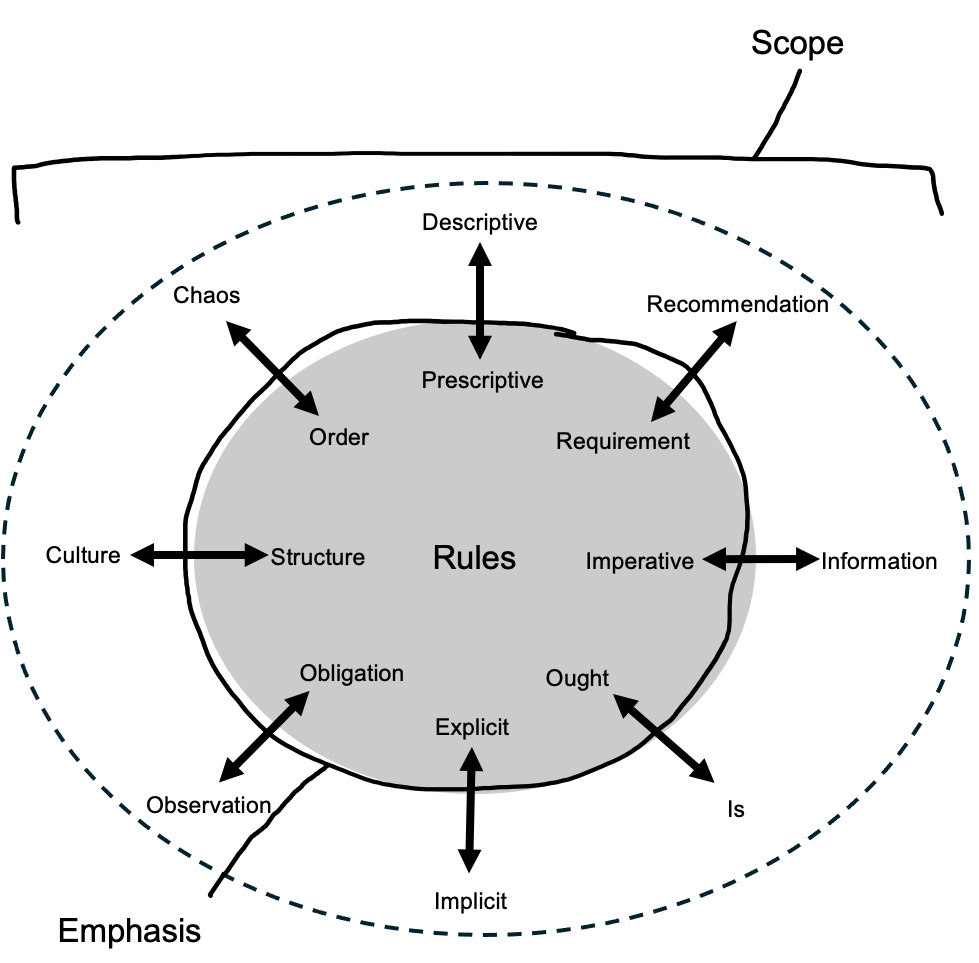
Before getting into the specific rule-related distinctions SOC proposes, scope must be addressed. First, this paper is a theory of rules and collaboration, not a theory of relationships in general. The object of analysis is collaborations in which ongoing, explicit, prescriptive expectations are part of the medium of work. The focus is the internal mechanics of collaboration itself—how obligations are authored, interpreted, enforced, contested, and revised within the system—whether at the individual, interactional, or institutional scale (see Model 4: The Three Practice Registers). Meaning, this paper is not primarily concerned with personal relationship dynamics as such.[10] However, collaborative scenarios that occur within or during a personal relationship (e.g., a friend group planning a road trip) would be considered in scope.
Second, this paper does not attempt to model predominantly emergent coordination carried by tacit alignment or moment-to-moment synchrony. Some collaborations operate largely through implicit mutual attunement, however the present inquiry targets a different class of situations: deliberate coordination where participants must reliably navigate explicit expectations, and where those expectations are treated as actionable obligations rather than mere descriptive norms. A parallel can be drawn to decision-making theory with its clear distinction between fast, automatic cognition (System 1) and slow, reflective cognition (System 2) (Kahneman, 2011). SOC’s focus is on the slower side: it examines how people deliberately construct, reference, and repair explicit expectations, and how those expectations become usable as guides for action and accountability.
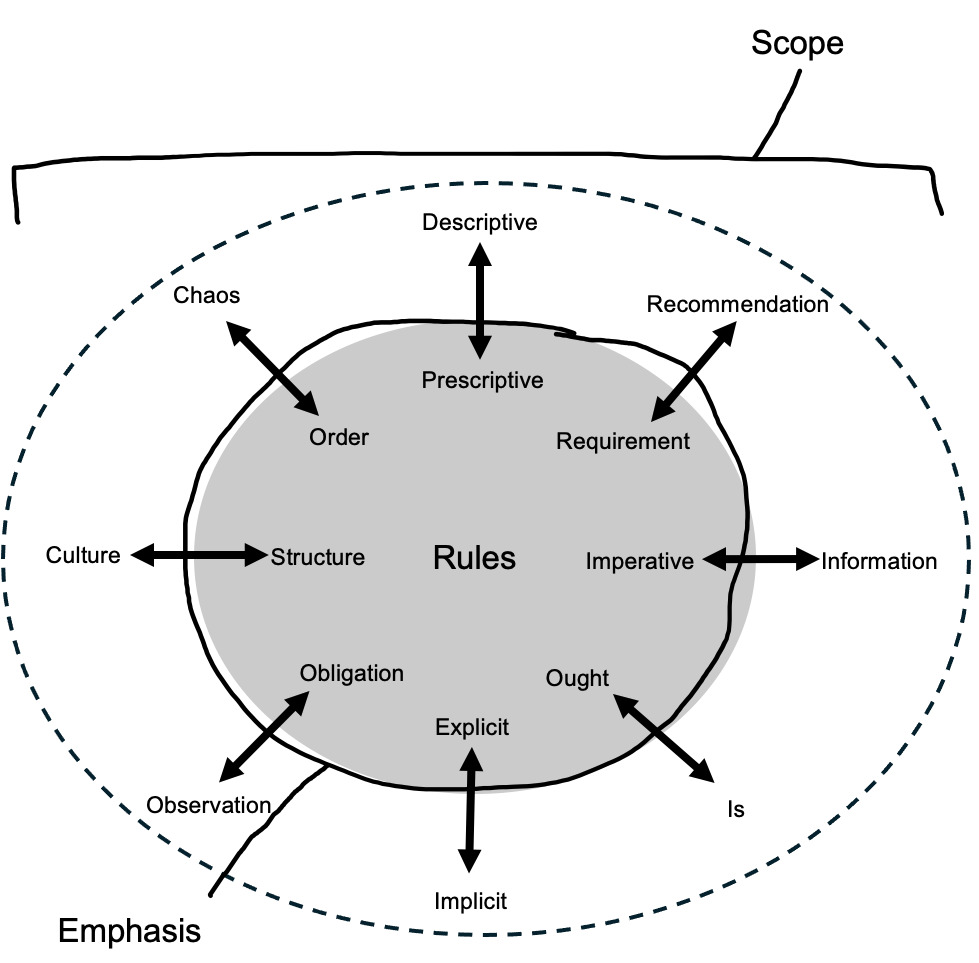
Third, this paper deals with rules as experienced and navigated inside collaboration and does not present a theory of law, society-level governance, or political legitimacy.
Fourth, SOC’s scope does not exclude sports and games—Searle’s (1969) work on constitutive rules and Suits’s (1978) philosophy of games both bear directly on it—even if they are not the focus here.
Finally, because SOC’s distinctions are subtle but consequential, Figure 1 presents the scope visually and marks a finer distinction of “emphasis” within it.
Origins of SOC
As previously stated, SOC did not emerge through abstract theorizing but sustained engagement with the self-management practice Holacracy.[11] Holacracy is an organizational operating system that makes a group’s shared structure unusually explicit and became popular with high-profile companies such as Medium and Zappos; HolacracyOne reports adoption by more than 1,000 organizations worldwide (Weirauch et al., 2023). Holacracy’s visibility increased further through its inclusion in Laloux’s (2014) analysis of “teal” organizations, where it was presented as an example of a social practice capable of supporting self-management, evolutionary purpose, and wholeness at scale.
As Robertson (2014) recounts, Holacracy originated as an integration of sociocracy and agile software development, and was further influenced by integral theory, Barry Oshry’s work, and Elliott Jaques’s Requisite Organization (1996). Holacracy provides an organization-wide framework and explicit rules for specifying how decisions are made, how roles evolve, and how authority is exercised, all defined in its constitution (HolacracyOne, 2021). Holacracy presents itself as a roadmap for any kind of organization of any size in any industry to adopt continuously evolving, rule-bound self-management rather than to rely on managerial discretion alone (Robertson, 2015). By operationalizing prescriptive expectations as roles, accountabilities, priorities, duties, etc., Holacracy aims to remove many of the informal buffers that ordinarily compensate for weak or ambiguous structure.
Notably, while Holacracy is unique in its emphasis on distributing authority and the depth of that application, it is not unique in its orientation to structure. Many collaborative approaches have demonstrated a similar emphasis on using explicit expectations rather than relying on mood, charisma, or positional authority (Lee, 2019). These approaches collectively fit what Constantine (1993, 1995) labeled the “open” organizational paradigm—one in which coordination is achieved through open communication and collaborative negotiation, with authority distributed and adaptive rather than fixed, and decisions reached through participative deliberation that balances stability with ongoing change. This stands in contrast to the “closed” paradigm associated with the management hierarchy, and the “synchronous” paradigm associated with groups whose members share enough context and vision to act in coordinated concert with little explicit communication or negotiation—the way a seasoned jazz ensemble or a long-tenured surgical team operates on shared anticipation rather than instruction.
Existing work suggests that, when implemented effectively, Holacracy can clarify roles and decision rights and support responsiveness in dynamic environments (Bernstein et al., 2016; Lee, 2019). These outcomes align with broader research on self-managing teams linking formalized autonomy to increased engagement and coordination under certain conditions like high task uncertainty, interdependence, and low routinization (Magpili & Pazos, 2018).
However, Holacracy also has many reported limitations. Reported implementation challenges include unfamiliar terminology, ambiguity during transition, and the effort required to learn new governance practices (Bernstein et al., 2016; Schell & Bischof, 2022). Practitioner accounts also describe procedural rigidity, coordination costs, and implementation processes that diverted attention from deeper organizational problems (Culen, 2016; Doyle, 2016; Van Gerven, 2019). Although these particular challenges were not my own, they resonated with my experience and helped prompt me to develop a fuller account of Holacracy’s limitations.
How Much Does a Group’s Culture Value Its Structure?
As a particularly extreme form of structure-oriented practice, Holacracy depends not just on defining explicit expectations, but also living into them, and revising them as often as necessary to maintain legitimacy. Indeed, the success and failure of Holacracy implementations seem to hinge upon how much the collective made explicit references in their internal communications to the structure they created (e.g., roles, domains), a habit documented in Lee’s (2019) empirical research. However, what has not yet been empirically substantiated, but a claim SOC makes, is that the mediating condition for success or failure with Holacracy is how much a group’s culture values its structure—i.e., that norms express the group’s collective beliefs about the importance, meaning, or utility of making their expectations explicit. For example, a culture with a low value on explicit structure would leave many formal expectations unwritten, treat all rules as equivalent in function and severity, assume expectations should be internalized rather than externally documented, and view explicit enforcement as a sign that something has gone wrong rather than a feedback system working well. Conversely, a culture with a high value on explicit structure would write down most or all formal expectations, distinguish among different types of expectations and their associated functions, and treat reminders and enforcement of explicit agreements as supportive not threatening.
The basis of this claim—independently discovered but well-documented in the literature—is that no matter how well designed the structures are, they do not self-define or self-enforce (V. Ostrom, 1980).[12] Seen through this lens, Holacracy may not have simply distinguished cultural concerns from structural ones, but dissociated them.
More optimistically, it could also be said that one of Holacracy’s innovations may be that it provides many structural solutions to structural issues. For example, agents in the system are not going to trust a structure that is inconsistently defined, and Holacracy provides its own constitution of structure-language with stable definitions that everyone can defer to (e.g., a “Purpose” is “a capacity, potential, or goal that the Role will pursue or express”; HolacracyOne, 2021, § 1.1).[13] Similarly, participants are not going to trust a structure that is inaccurate or outdated, and Holacracy gives every circle a way to ensure its own inner structure is as accurate and current as it can reasonably be. Also, people are never going to be able to objectively determine when something needs to be captured explicitly and when it can remain implicit, but Holacracy’s tension-driven approach allows anyone in the system a pathway to propose a structural change while ensuring its final form has the consent of everyone impacted, or in lieu of that, a repair pathway. This, combined with its base interpretative condition that “any action is permitted unless explicitly forbidden by a legitimate authority” (Daniel, 2014), means Holacracy’s design has the property of being both fully participatory while also reducing the likelihood of over-formalization.
However, the structural mechanisms do not work on their own. Therefore, it seems that in Holacracy’s conviction that good structure is a better lever for change than trying to change people’s hearts and minds (one that SOC supports), it over-corrected. Regardless, when Holacracy is understood not merely as a set of rules but as a practice—one that demands sustained discipline in referencing, updating, and acting on explicit agreements—its successes and failures become intelligible within a single explanatory frame.
SOC emerged in the context of coaching Holacracy because that framework lacked the language to fully justify its structure-oriented approach. But existing rule theories were missing necessary language too, and likely for a more basic reason.
A Missing Referent: Reliance
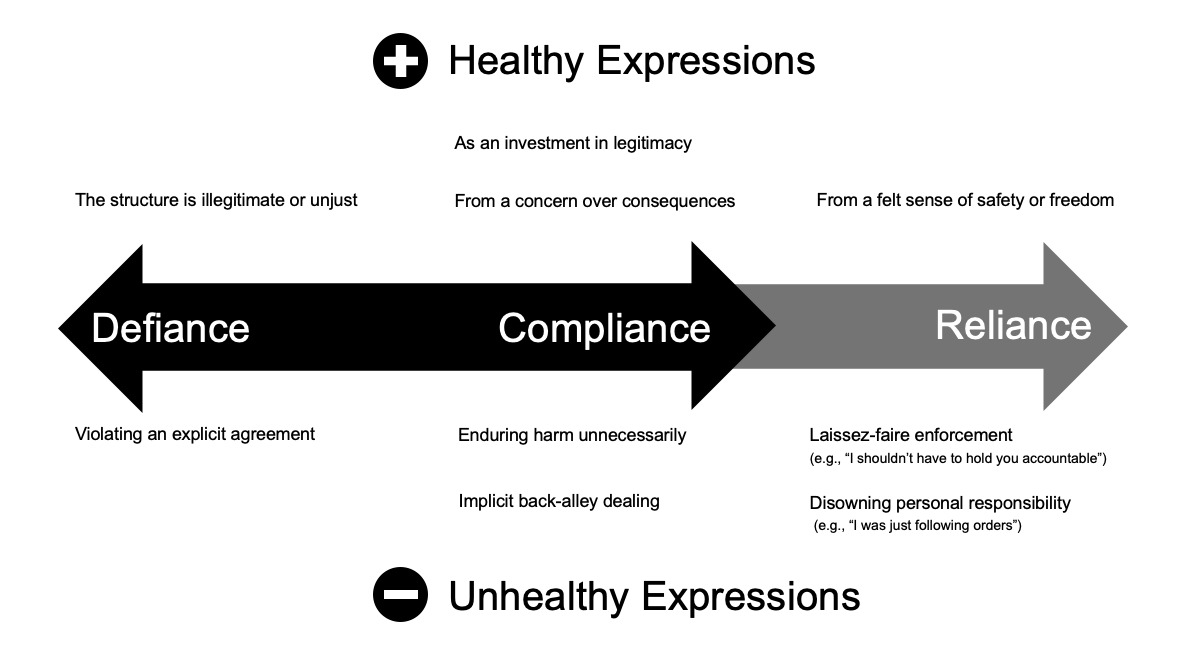
An experienced Holacracy practitioner once said, “Trying to explain Holacracy to someone who has never experienced it is like trying to explain how to change the oil in your cat.” It is a good way to express the complexities of communicating one’s unique experience, and is relevant for understanding SOC’s approach to rules and collaboration because most accounts of rules and rule-following treat compliance and defiance as the only stances available to agents in relation to rules. Yet this framing obscures a common nonwork experience that becomes necessary in self-managing systems: reliance.[14]
Three experiences illustrate the concept. One is using an explicit structure as an enabling constraint—reducing uncertainty, lowering coordination costs, letting action proceed without continuous negotiation or oversight. This is familiar in traffic systems, games, and technical protocols, but far less theorized in collaboration. Metaphors can gesture at it—the lines on a highway constrain and thereby improve safety and flow—but the felt sense is hard to transpose into a work context without direct experience.
A second and equally under-modeled experience is holding the line: enacting accountability by leaning on an explicitly consented-to expectation rather than on personal authority or discretionary judgment. It is central to meeting facilitation in Holacracy, and to leadership theory in which legitimacy flows from agreement and transparency rather than status.
A third experience is encountering a binding expectation one dislikes while still experiencing it as legitimately obligating. The agent complies, or pursues a legitimate pathway for revision, much as a rushed driver can dislike a red light while still treating it as having the right to bind them.
Because these experiences are unevenly distributed in collaboration,[15] they rarely appear as primary cases in rule theory, which tends to favor constructs like “norms” that treat explicit rules as a mere supporting mechanism. The absence of these experiential referents constrains what existing frameworks can see (Wilber, 2017a).
Critically, reliance is not offered here as a superior stance or an ideal for all collaboration. A framework meant to account for every form of collaboration has to treat defiance and compliance as equally acceptable stances—each is the right response under the right conditions. What reliance adds is not a higher rung but a fuller picture: placed alongside defiance and compliance, it shows that every stance carries both healthy and unhealthy expressions (see Figure 2).
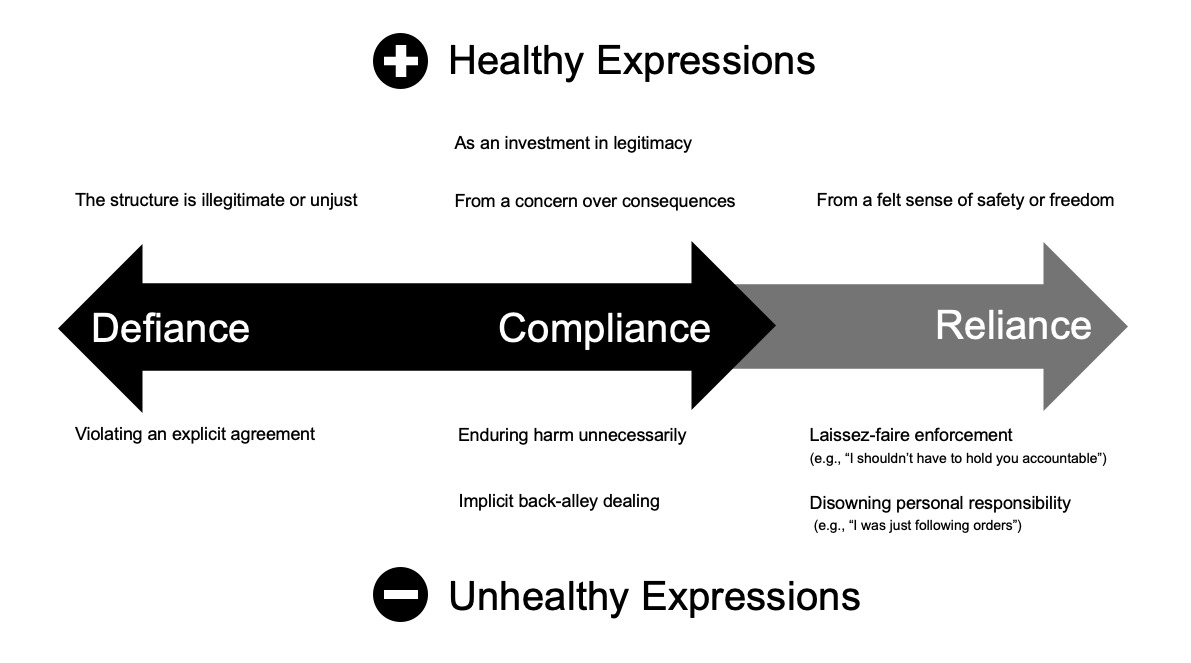
Where the enabling-constraint and non-dominating accountability experiences are absent from the analyst’s world, rules are inevitably interpreted through narrower lenses—typically as instruments of control. However, a self-managing context makes it more obvious how all participants are necessarily engaged in the meaning-making processes of legitimacy, even if they are not officially or consciously doing so.[16] The result is not merely an incomplete explanation but large-scale misrecognition of entire classes of rule-related phenomena.
In sum, the origins of SOC are not a priori conceptualization, but a real-world need to tell Holacracy coaches and practitioners how to properly use rules to resolve their coordination challenges. However, the need alone was not enough. Several new distinctions were necessary.
Core Models
The next section covers four core models that are both constitutive and representative of SOC. While they vary in detail and application, together they should provide a working sense of the approach, even if not a complete one.
Model 1: The Awkward Drift Toward Explicitness
The first model presents the central conceit of the approach: explicit expectations are often required to resolve the distance and diversity challenges of people working together toward a shared purpose. The logic of this conceit is presented here in its most economical form.
Distance and diversity generate a predictable drift toward explicitness. Coordination is the core problem of collaboration and it grows harder as work spans space and time, since shared context and mutual knowledge degrade without deliberate mechanisms. Diversity compounds this: a collection of different cognitive and creative capacities explores the solution space more effectively (Page, 2007), but that same heterogeneity raises the need for explicit coordination about meaning, roles, and expectations.
As these demands rise—and absent mindreading—groups make their shared expectations explicit, because informal memory and tacit, high-shared-context alignment do not scale or integrate human difference reliably. Those expectations are expressed in both descriptive terms (e.g., informational, observational) and prescriptive terms (e.g., injunctive, obligatory), with the recurring prescriptive ones encoded into rules and structures that stabilize expectations across contexts (Malone & Crowston, 1994). This drift is visible in classic accounts of bureaucracy as rule-governed administration that increases as coordination demands rise (Pugh et al., 1969; Weber, 1922/1978).
Explicitness is a function of lower shared context. Hall’s (1976) research on cross-cultural differences found that communication varies in how much meaning is carried by the explicit message versus the surrounding context: low-context cultures state meaning directly in words, while high-context cultures leave much of it in shared background and relationships. But such a preference often tracks a systemic condition: Henrich (2020) argues the WEIRD[17] reliance on explicit, impersonal rules is not temperament but the residue of kin networks dissolving into exchange among strangers, where explicit norms became a need, not a preference. Where common ground is thin, a preference for explicitness may reflect not disposition but a coordination requirement.
The drift back to implicitness is stunted by over-formalization. Concomitantly, as shared context increases, whether incidentally or by design, the pressure for explicit structure decreases. However, that drift back will likely be stunted by formalizations already in place. A rule that has hardened into a norm may no longer be needed, but rules also carry an “expressive function”—they signal what is valued rather than merely control behavior (Sunstein, 1996)—so removing one rarely reads as neutral. As collaborations typically lack explicit second-order structures for updating or removing structures, the result is that groups drift not only toward explicitness in general, but toward over-formalization: rule creation outpaces removal, and policies accumulate (March et al., 2000).
The drift to explicitness is inherently awkward. In addition, making expectations explicit is necessarily awkward because people must use communication to solve their communication problem and resolving that ambiguity takes effort. And since one party usually feels the need for more clarity before another, requests for clarification may be experienced as face-threatening and, in some contexts, interpreted as pedantic or controlling (Brown & Levinson, 1987). In this way, seeking clarification may be an unwelcome reminder of distance or separateness—evoking feelings of alienation rather than alignment. This then creates an anti-pattern in which differences are not acknowledged, and perceptions diverge further.
People mistakenly blame each other for the awkwardness. The pressure for more explicitness can generally be read in two ways. One—as was brought up in more than one Holacracy training—is as an unconscious bias towards masculine, positivistic, or Western values. Or two, as a developmental requirement that emerges when people must coordinate across time, space, and individual differences. SOC adopts the second reading while staying attuned to the first.[18] The confusion over what is attributable to personal preference or disposition[19] leads people to attribute their feelings of discomfort or disorientation to the presence of the other person rather than otherness itself. Without access to an alternative explanation, the felt pressure gets interpreted as the other’s implicit demand, rather than the mutuality demanded by communication.
Explicitness-potential exerts a gravity on all collaborative efforts. Even when implicit alignment is working and there is no acute need, collaborative terrain remains inherently unstable. Unlike an individual holon, organized by a dominant monad (Whitehead, as cited in Wilber, 2001), a social holon has no center—only a “we-ness” continually reproduced through communication (Luhmann, 1984/1995). Because members join and leave at will, its coherence is never given, only maintained. So, as distance grows across space and time, and heterogeneity across perspectives and lived experience, that coherence becomes harder to hold implicitly, and the pressure toward explicit structure intensifies. The point is not that explicit structure is always desirable; it is not. It is simply recognizing that directionality has impact even if it is only potential impact.
If shared expectations drift toward explicitness, then the central collaborative challenge is how well participants navigate that drift. The label “structure-oriented” is meant only to convey that the drift toward explicitness is a predictable feature of collaborative terrain, not that explicitness is superior. In that spirit, SOC attends to conditions, not verdicts: not to whether explicitness is warranted in the abstract, but to when and why the pull toward it tends to intensify. And when that pull arrives—prompted by a new member, a scaling threshold, a coordination failure, or simply the passage of time—what matters is how well a group can recognize the shift and respond, whether by making some expectations explicit, by reducing rules, by building more shared context, or by judging the ambiguity not worth resolving. SOC is animated by these concerns.
Model 2: A Definition of Structure
The second constitutive model of SOC is how this approach defines structures and rules. Across disciplines, “rule” refers to a wide range of phenomena (see Approach), but as a theoretical and methodological orientation concerned with understanding how rules function, SOC must clarify what it is treating as its central object of inquiry.
To do this, SOC introduces orienting definitions that progressively narrow analytic focus. At the broadest level, rules may be understood simply as requirements: explicit standards specifying what must or must not be done under certain conditions. A second definition treats rules as independent reasons for action, meaning that a rule influences an individual’s behavior (when they do) by applying a felt sense of normative force—i.e., people follow rules because they are rules (Schauer, 1991). A third definition, which anchors SOC’s distinctive analytic focus, defines a rule as any ongoing, explicit, and prescriptive expectation.
Ongoingness. This dimension distinguishes rules from one-off directives or isolated commitments. An ongoing expectation is designed to travel across time and space; meaning it must remain locatable, interpretable, and action-guiding even when the original authorities are absent and local contingencies vary (Hart, 1961). Enduring rules disproportionately recruit deliberative, reflective processing because participants must reapply a generalized expectation to new particulars without relying on situational cues alone to carry meaning (Kahneman, 2011).
Explicitness. This dimension distinguishes rules from tacit norms or background habits by making expectations referable—something people can point to, invoke, contest, or revise together. Norms are real and powerful, but they operate differently: they are inferred rather than articulated, enforced indirectly rather than explicitly invoked, and revised implicitly rather than deliberately (Brandom, 1994). The combination of ongoingness and explicitness means that rules are recorded somewhere, typically in written language, connecting them to theories of textual agency that show how texts can perform functions (Cooren, 2004).
Prescriptive expectation. This dimension distinguishes obligation from information, prediction, or preference. Prescriptive expectations establish standards that claim some authority over action—standards that participants can be held to, justify themselves against, or contest when circumstances change. The purpose of this distinction is to separate “what is” from “what ought to be,” not as rigid philosophical categories, but to cultivate attentiveness to when descriptive predictions (i.e., projections, observations) should be distinguished from prescriptive propositions (i.e., promises, obligations).[20] Under this definition, rules include laws and policies, but also commitments, agreements, strategies, role definitions, priorities, projects, targets, heuristics, and values—provided these are operationalized as ongoing, explicit, and prescriptive expectations. The decisive question SOC asks is not how an expectation is labeled but how participants use it to guide decision- and sense-making.
No Dogs Allowed
Calling back to the section Why Rules Feel Wrong, one challenge with proper rule-operationalization is that rules feel fundamentally flawed. But in addition to the historical or cultural reasons already mentioned, perhaps rules feel flawed because they are. A rule must do something reality does not do: it must draw a stable boundary. It must say “this counts” and “this does not.” It must invent a label for what actually matters, because it cannot carry the entire richness of the thing it is trying to manage.
Schauer makes the point clear in Playing by the Rules (1991) that rules must trade accuracy for generality. They assist coordination precisely because the participant does not have to re-evaluate the rule’s justification in each new case. But Schauer explains that this feature makes a rule wrong in two directions at once and gives this illustration. Imagine a sign at the entrance to a restaurant says, “No dogs allowed.” The point of the prohibition is not really about “dogness.” The point is some cluster of concerns like hygiene, safety, or loud and disruptive behavior. But the rule cannot encode that whole cluster of reasons and instead picks something more legible and enforceable, and so it encodes “dog” as a proxy. However, this creates two immediate problems.
First, the rule over-specifies. The rule elevates “dog” as the standard, even if “dog” is not what is operationally relevant in a given real-world situation. A guide dog is still a dog. A small, clean, quiet dog is a dog. If the underlying concern is cleanliness or safety, those cases don’t violate the spirit of the rule, yet the rule captures them anyway.
Second, the rule also under-specifies. Because the rule has committed to “dog,” it necessarily leaves out other cases that would fit the justification more directly. A man wearing a beard of bees is not a dog. A ferret is not a dog. A disruptive patron is not a dog. So, if the underlying concern is a clean and calm environment, those cases can violate the purpose of the rule more than a well-behaved dog, yet the rule lets them pass because those cases are not named explicitly.
This deeper analysis supports not only the claim that rules always depend on interpretation, but that a rule can never be fully defended from objection. Yet losing the hope for reliable rules means losing an illusion as well—it moves the question away from whether a rule is finally “right,” past even how it should be interpreted, to how it is operationalized.
Managing a Polarity of Stability and Flexibility
Seen this way, operationalizing a rule is less a matter of getting it right once than of managing a standing polarity between stability and flexibility (Johnson, 1992). A rule’s abstract generality is the source of both: that generality is what lets one expectation hold across many cases, and the very same generality is what forces context-sensitive judgment when a case does not quite fit. Stability supports alignment; flexibility supports adaptation. Neither pole can be maximized without cost. A structure that is too flexible never delivers the order it was built to provide. Yet a structure that is too rigid endangers that same order from the other side: unable to bend, it snaps under pressure, failing all at once rather than adapting. And because social holons are always being reconstituted, rule-structures must not just strike this balance once, but continually.
This framing clearly locates the rule within something larger. It is one part of a broader system of legitimacy and norms that, together with the rule, attempts to manage a recognizable and relatable polarity. The implication is that when the rules are operationalized poorly, the system will repurpose them or work around them. For example, if there is too much flexibility, the system might pressure participants to get aligned on their beliefs and opinions. Or if there is too much stability, the system might pressure leadership to selectively enforce rules.[21] These adaptations are not random, nor reducible to bad faith. They are incentive-consistent solutions motivated by system needs.
Model 3: The Structure System of Exploring, Encoding, Enforcing, and Evolving
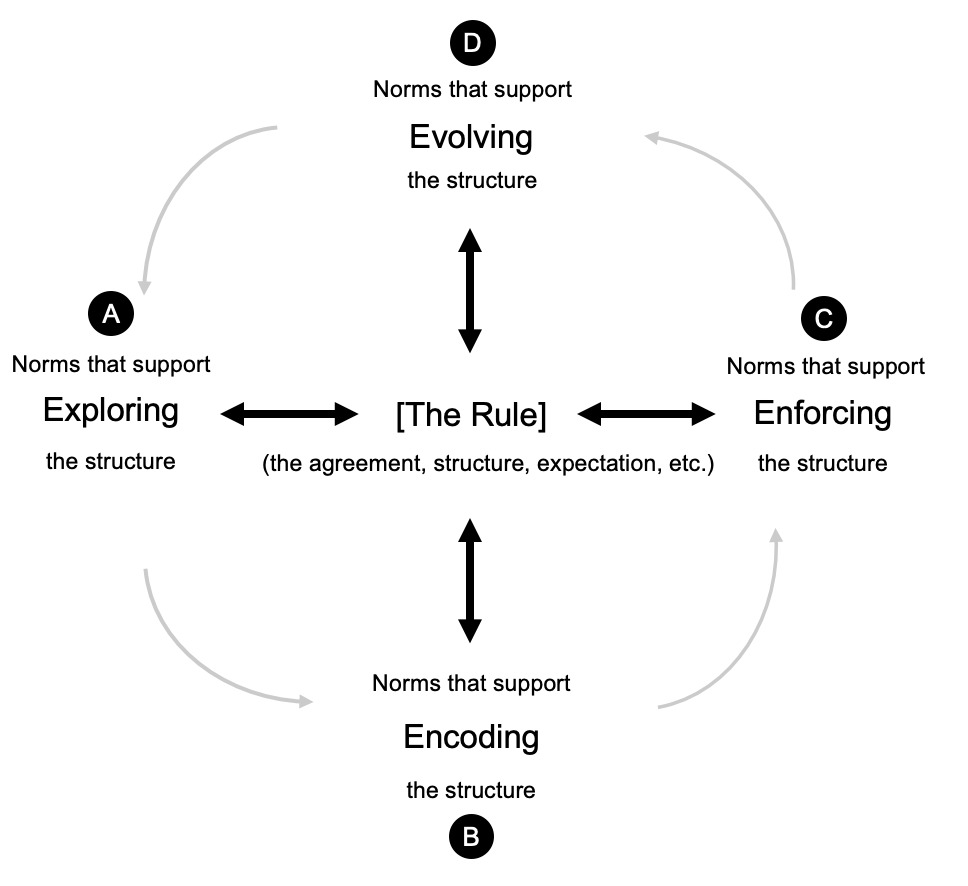
While the previous two models are important, it is with Models 3 and 4 that SOC’s targeted diagnostic power becomes more salient. In this regard, the structure system model builds on the previous work but provides a more detailed map for how structures are operationalized. It distinguishes four analytically separable but dynamically interdependent dimensions: Exploring, Encoding, Enforcing, and Evolving (see Figure 3). Each aspect corresponds to a distinct dimension in the web of norms that support (or fail to support) the legitimacy of a given rule and is oriented by a characteristic question that shapes its contribution.
Exploring. Exploring includes all of the activities before the structure becomes officially binding. Holacracy’s definition of “a tension” is useful here, as SOC similarly sees that the entry point for anything into the system (operational or structural) is that at least one participant feels a tension.[22] Examples of exploring activities include anything from private self-reflection or conflict resolution discussion to a multi-year multi-stakeholder committee recommendation. Its primary structural function is to determine if a structural intervention is warranted at all. This dimension resists the assumption that every issue requires a new rule, policy, or agreement. It attends to the nature of the issue, who experiences it, and which stakeholders should be invited into the inquiry. It also examines existing structures, tools, or environmental conditions that already shape the situation, and explicitly includes the possibility that the appropriate response may be nonstructural. When deliberate exploring is absent or truncated, systems predictably accumulate expectations they will not enforce or remove (unless those dimensions are consciously considered).
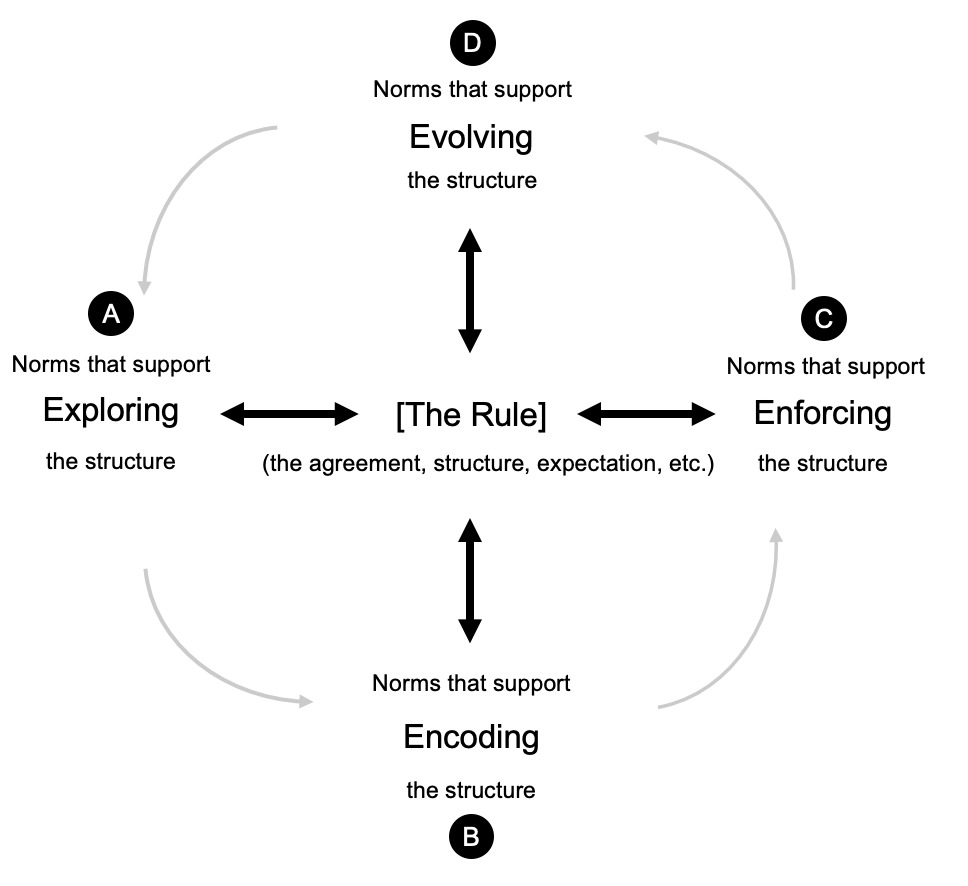
Encoding. Encoding means any activity or concern involved in making the expectation “official”—including its phrasing and location of record—according to the standards of that system. It addresses the question: when precisely does an expectation become binding? Examples include the sociocratic governance process, a multi-year, multi-stakeholder approval process, or just a restaurant owner telling their staff, “And no guys with bee-beards either.” The key is that encoding marks a transition from information, suggestion, or recommendation to official obligation. This mirrors the language practice of sorting non-binding from binding information, and raises questions of standing and legitimacy: who has authority to encode the expectation, through what process, and with what recordability and communicability?
Encoding also includes formulation choices—how specific or general the phrasing of the expectation should be and how much interpretive discretion it affords. These elements can be explored in advance (exploring) or decided upon in the moment. In addition, expectations that are difficult to revise later will likely require a higher threshold for approval, whereas expectations that can be easily changed will have a lower standard to meet.
Enforcing. Enforcing is everything related to referencing the structure as a shared expectation, including responding to violations. From a systems perspective, it is the feedback loop that addresses the question: how does a structure continue to matter in practice? In SOC, enforcement is not synonymous with punishment, nor is its primary function compliance (though both are fully embraced as appropriate in certain conditions). Enforcing is the ongoing work of stabilizing a structure’s salience as an independent reason for action. This includes responding to violations and calibrating consequences, but also providing reminders, adjusting access or tooling, and supporting sensemaking. Neutral but firm enforcing echoes the high-consideration plus high-structure leadership stance evident in good traffic cops or referees. But regardless of quality or content of the interaction, enforcing is not reducible to what a participant imagines or fears, but the system’s response to what happens when the expectation is violated. Enforcement failures often reflect system deficiencies such as the structure lacking a justification (exploring), vague phrasing (encoding), or missing amendment pathways (evolving).
Evolving. Evolving is the dimension that acknowledges every structure has a second-order[23] pathway through which it can be changed or removed, even if it is unreliable or unspecified. Evolving addresses the question: how does the system ensure the structure remains relevant over time? This dimension maintains relevance and systemic health by preventing expectations from persisting beyond their usefulness. Review cycles, expiration dates, trigger conditions, and opt-out provisions lower the stakes and approval thresholds and enhance the confidence of agents and enforcers to lean on their interpretations and judgment. When done consciously, evolving can help curb over-structuring by making it lower-stakes to remove mummified policies, but it can also—counter-intuitively—lower the stakes at encoding, making it easier to add them.
In summary, having language for the implicit web of norms around a rule enables at least three observations. First, some elements attributed to culture, psychology, or personal preference, may be predictable system dynamics. For example, a lack of a clear evolving process will often impact encoding because participants are less clear what they are actually deciding (e.g., if an agreement can easily be revisited in a month, there is less pressure to make it perfect). This dynamic is recognizable irrespective of the seriousness or complexity of the issue itself.
Second, since Locke, the consent of the governed is the founding principle of democratic legitimacy—the reason a governing structure is thought to have any right to bind at all. Treating consent as one dimension of legitimacy, rather than its sole foundation, is a claim with implications well beyond the workplace. And yet the structure system shows that consent speaks to only one of the four dimensions: encoding. Consent matters, but legitimacy can also be built, degraded, or repaired through the others; a transparent and reliable evolving process, for instance, lets a rule earn legitimacy over time even for those who had no say in its making (Tyler, 2006). Consent, then, is one route to reduced alienation, not the only one.[24] In this way, SOC transfigures this cherished principle into something a group can act on even where consent is absent, partial, or impractical—an actionable answer where most theories offer only ideals.
Third, while the structure system model tracks a single structural object, it acknowledges that structures are not all of one kind. A commitment to “assume good intent,” a request to weigh environmental impact when purchasing, and a policy requiring approval before taking leave are all explicit, ongoing, prescriptive expectations, yet each obligates differently. SOC accordingly distinguishes several functional types, and the difference does real work: a requirement to consider, rather than one to honor, leans more on discretion than on enforcement, and so asks for more investment in exploring and encoding than in policing compliance.[25]
Each of these observations, though, has been drawn at more or less one analytical level: the group. The final model asks whether the structural orientation is confined to that level, or whether the same mechanics appear above and below it.
Model 4: The Three Practice Registers
The structural orientation, it turns out, is not confined to the group. Institutional structures do not stand on their own; they are continually reproduced and transformed through individual action and interpersonal exchange (Archer, 1995; Bhaskar, 1979). A structural account therefore has no principled reason to stop at the institution: the same obligation mechanics (exploring, encoding, etc.) that organize governance also operate within a person’s own commitments and between people in dialogue. SOC accordingly spans three distinct but interoperable registers—individual, interactional, and institutional. Recognizing this recurrence carries both explanatory and practical consequences, and it is what lets SOC operate as a single language practice and collaborative grammar rather than three disconnected ones.
As with the rest of SOC, this framing was not derived a priori. It emerged from repeatedly seeing participants grapple with how to identify what needed structuring, make the resulting expectations explicit, uphold them, and revise them over time.
The individual register concerns how a person manages their own commitments and navigates as a citizen of differing social environments. An exemplar practice[26] in this register is Allen’s Getting Things Done (GTD; Allen, 2015), whose training and coaching companies, not incidentally, practice Holacracy. The commonalities between Holacracy’s paradigm and GTD’s were expressed by Allen himself when he described Holacracy as “GTD for organizations” (David Allen Company, 2024).
The individual register also encompasses internal negotiation among competing priorities and commitments—what might be understood, by analogy to Schwartz’s (1995) Internal Family Systems model, as something akin to inner collaborative systems whose parts must coordinate under a shared purpose. Exemplar practices for this are Kelley’s (2009) true purpose work and Kegan and Lahey’s (2009) immunity-to-change mapping.[27]
The interactional register concerns real-time and asynchronous communication between participants—dialogue, meetings, etc. This register foregrounds a paradigm of interactivity oriented around making one’s desires and requests explicit to others. Exemplar practices for structurally oriented communication protocols are Nonviolent Communication (NVC; Rosenberg, 2015)[28] and Getting to Yes (Fisher et al., 1991). Perhaps though, the most obvious connection is to meeting protocols with a notable exemplar being Lipmanowicz and McCandless’s appropriately titled Liberating Structures (2014).
Finally, the institutional register concerns a collective’s governance architecture—roles, policies, decision-making protocols, authority structures, and the second-order processes through which these are created and revised. As already discussed, exemplar practices include agile, Holacracy, and sociocracy.
To conclude, the analytic value of this three-register model lies in two properties. First, it enables learning transfer because the same operationalization issues surface in each, meaning experience or insight gained at one scale may develop capacity at the others. A person who becomes skilled at managing individual commitments can locate structurally homologous dynamics in organizational governance, and vice versa. This also means that institutional dynamics are not exotic phenomena requiring positional authority to understand; they are available in a participant’s own experience at any scale.
Second, the registers are independently deployable. A participant can adopt structure-oriented practices like GTD at the individual register without requiring full institutional adoption, and an organization can implement structural interventions without requiring that every individual agree to adopt the same personal habits. The model of registers does not itself impose a coordination requirement or a critical-mass threshold for basic functionality yet still allows for the possibility of combining effects.
Key Claims
Admittedly, a lot of ground has been covered very quickly. But taken together, the drift toward explicitness, a definition of structure, the structure system, the three registers, and all the preceding context should convey a general sense of SOC’s shape and texture. In addition, given that breadth, the claims provided below act more as distillation than extension.
Claim 1: Coordination drifts toward explicitness. The drift toward explicitness is a necessary condition of social holons with low shared context. In addition, the drift is necessarily awkward and therefore often misdiagnosed as a people-problem. All involved would prefer implicit mind-melds, but when synchronous flow is absent this gap gets projected onto people individually or assumed to reflect positional or dispositional bias (e.g., patriarchal, positivistic, WEIRD). The claim is that while the preference, form, and tolerance of explicitness may be culturally shaped, the directionality towards explicitness, as shared context lowers, is not. If evidence can be found of a low shared context, high-diversity group that coordinates durably with no significant drift toward explicit structure, it would be a serious threat to SOC’s current formulation.
Claim 2: The participant-centered paradigm is needed and already emerging. SOC has a constellation of core models, but is also defined by its perspectival priority: participant navigability. Much like how UCD was an organic response to the democratization of computing, a field response is predictable in light of broadening concerns once only the province of managers, politicians, legal scholars, and specialist consultants. My Holacracy experience was catalytic in recognizing that its novel mechanisms could be distilled and applied to all collaborative contexts. Therefore, if these distinctions fail to resonate outside of self-management contexts, then the theory would need serious revision to its proposed scope.
Claim 3: Rules—defined as ongoing, explicit, prescriptive expectations—are a first-class social object. By making rules contrastable with descriptive expectations (i.e., predictions, projections, intuitions, etc.), SOC enables a multi-register language practice. Since coordination requires the constant assessment of what others will do or need, this reveals how rules and information do similar things, but also how their functioning differs as the mediating effects of shared context are felt. Collaborations—as social holons—are always being reflected and reinforced through the words participants use. SOC applies this to the narrow use-case of rules, which carry the added burden of trying to operate as independent causes for action. And because rules are necessarily generalizations, they can never fully work independently of the web of norms around them. However, explicit rules are not purely derivative or secondary objects. Yes, they reflect the culture, but they also help shape it. As levers of influence, structures offer more efficient and more humane points for intervention—not to the exclusion of information—by making expectations and authority legible, contestable, evolvable, and accountable. The claim here is a structure-orientation should generally outperform mood-orientation (i.e., letting individual emotion or collective mood override shared purpose, agreements, or values) in preventing and resolving breakdowns.
Implications
Since rules are everywhere, SOC’s implications are everywhere. However, for the purpose of this introduction, perhaps two are the most relevant.
A Research Program
SOC has a clear research path. First—because SOC treats explicit, ongoing, prescriptive expectations as a single object of inquiry—it offers a shared lexicon to lineages that have studied rules largely in isolation from one another. The closest and most developed of these is the institutional analysis of Elinor Ostrom, whose account of how communities govern shared resources earned the 2009 Nobel Prize in Economics (E. Ostrom, 1990). Ostrom went furthest toward what she and Crawford called a “grammar of institutions” (Crawford & Ostrom, 1995). Yet she was candid about where that tradition fell short: its most powerful tools, hers among them, were built for static analysis rather than the dynamic evolution of rules and norms (E. Ostrom & Basurto, 2011). SOC is the predictable complement. As an account of how rules are made and remade, it takes up the dynamic gap she named but reshapes the whole inquiry around participants. And this is but one example.
Second, participant-facing distinctions lend themselves particularly well to empirical research. Because participant navigability targets perceptions, beliefs, and behaviors rather than structures visible only to an outside analyst, SOC yields hypotheses that social science can actually measure—often through self-report. In turn, this approach to understanding how rules function in collaboration offers a bridge from practice to theory and from theory to practice.
Navigating the Age of Algorithms
Twenty years ago, Lessig (2006) observed that privately owned algorithms were regulating social conduct and shifting decisions away from democratically accountable domains of law and politics.[29] But the algorithmic transformation continues. Human collaboration is no longer just enabled by technology—through the integration of AI—it also gives that technology official standing within its own collaborative systems. As people delegate more execution to autonomous agents, their instructions to AI draw on existing expectations about how work should be coordinated (Zhang et al., 2020). And the questions this raises—what to delegate, what harnesses (technical or social) to require, and what should be done if things go wrong—are all, fundamentally, questions about rules. SOC offers a unique way to understand AI delegation as a structural question: what authority is being granted, what expectations guide its use, and how those expectations can be revised when they fail.
Limitations
As an initial formulation, SOC is necessarily provisional and self-reflective. Yet two limitations warrant explicit acknowledgment, beyond the general qualification that some of the models and claims are expected to be revised.
First, I believe it is necessary that the approach disclaim—once again—that explicitness is always desirable or that implicit coordination is inherently inferior, though this remains a predictable misreading. If the approach claims to focus on participant navigability, then foregrounding words like “rules” and “enforcement” will unfortunately turn off some of those very participants.
Second, SOC theorizes rules without a developed theory of resources. This is not from neglect, as the material and physical connotations of “structure” are intentional (once again echoing elements of design). In addition, physical layout and environment, and the decision architecture of computer tools, are often appropriate leverage points for shaping behavior. However, while rules remain the focus, the normative force rules provide (when they do), must be understood within the context of other forces, particularly economic incentives and environmental conditions. Thus far, SOC leaves those critical dynamics underdescribed. Upon fully integrating them, the theory itself could require revision.
Conclusion
In 1970, Jo Freeman delivered a speech called “The Tyranny of Structurelessness.” She was addressing a women’s liberation movement that had come to treat the very idea of formal structure with suspicion. Freeman (1972) argued that structurelessness is an illusion: a group that refuses explicit structure does not thereby become egalitarian—it cedes power to informal, unacknowledged, and therefore unaccountable elites, a hidden tyranny harder to contest than any explicit one. Freeman, like Holacracy, framed structure in the language of power. This paper has traced the same logic across a wider field—how people everywhere communicate and coordinate across distance and difference. SOC’s contribution, at this stage, is not to prescribe optimal systems or governance forms in the abstract but to specify the functional consequences of different structural choices, including when it is best to leave them unspecified. Its work is to name the grammar beneath existing patterns, so participants can consciously and meaningfully attend to them. In doing so, SOC aims to support a more coherent and caring intellectual commons—one in which rules are no longer seen as an expression of humanity’s fall, but as an under-appreciated and powerful way we can hold each other up.
“Coordination,” “collaboration,” and related terms are used broadly and interchangeably. Meaningful distinctions among those terms exist (e.g., Bedwell et al., 2012), but nothing in the paper requires them.
See “The Five Participant Roles: Agent, Author, Enforcer, Analyst, and Dependent” (Cowan, 2026a). Importantly, “Analyst” here does not mean outside the system but represents a perspective-taking position of someone in the system. For example, an HR person trying to address a conflict issue they are not directly involved in, or a manager taking a step back to look at team dynamics.
SOC has a model explaining this stance published as “Three Layers of Social Coordination: The Wild, Norms, and Explicit Structure” (Cowan, 2026b).
One could argue Alexander’s definition of “pattern” is so expandable—explicitly stating that patterns exist within patterns—that SOC is also just a broad pattern language. To this I would have no principled objection, but would qualify that there is at least a meaningful difference in the level of pattern being articulated.
For an earlier formulation of Holacracy as a language practice, see “Holacracy Communications Framework: A Rosetta Stone for Holacracy-Powered Companies” (Cowan, 2018b).
There is a full treatment of this distinction with video examples provided here, “Why You Shouldn’t Expect Favors: Descriptive vs. Prescriptive Expectations” (Cowan, 2019).
At minimum, a Kosmic address locates a referent in AQAL by altitude and perspective, reflecting the premise that phenomena are enacted rather than simply given (Wilber, 2006). Integral Life’s (2026) GigaGlossary was consulted as a terminology aid.
These are interpretive mappings of the primary zone orienting each cited contribution; the authors did not use IMP terms, and their broader work may span zones.
SOC provides lots of distinctions and mental models, but considers training and workshop experiences to be equally important (if not more so) as navigational aids.
See “The Three Spheres: Information, Relationship, Collaboration” (Cowan, 2025c).
“Holacracy” can mean at least three things: (a) the rules of its constitution, (b) the real-world practice and its ecosystem, and (c) the broader paradigm it conveys. This paper uses the second sense throughout and uses “constitution” where the first is meant. The third does not appear as such: where that paradigm is what matters, this paper calls it SOC, on the view that what people reach for when they invoke Holacracy as a paradigm is broader than just its ruleset.
This observation is also validated by Taylor’s essay “To Follow a Rule” (1995), which draws heavily on Wittgenstein’s (1953/2009) claim that “obeying a rule is a practice” (§ 202).
Holacracy’s constitution, its stable definitions of terms, and its governance meeting process together perform the work of what Hart (1961) called “secondary rules”—i.e., rules about the rules, by which a system’s primary rules are recognized, adjudicated, and changed.
Notably, reliance is similar to the “enabling” pole of enabling-versus-coercive formalization (Adler & Borys, 1996), but is closer to the “secure base” of attachment theory (Bowlby, 1988).
DeHart-Davis’s (2009) research on “green tape” in local government is a notable exception.
SOC treats legitimacy as two independent vectors: “structural,” whether a rule was made through valid authority and proper procedure—and “experiential,” whether participants actually feel it has a right to bind them. These vectors present four legitimacy profiles: Aligned (high in both), Alienated (high structural, low experiential), Assumed (high experiential, low structural), and Absent (low in both). For a fuller description of SOC’s model of legitimacy, see Author (2026d).
Western, Educated, Industrialized, Rich, Democratic.
See “You Can’t Prove You’re Not Biased, But You Can Prove You’re Trying Not to Be” (Cowan, 2026c).
The gendered version of this reading has a long lineage. Kohlberg’s (1981) stages of moral development associated mature reasoning with an orientation toward justice and explicit principle, and his samples showed men reaching those stages more often than women. Gilligan (1982) countered that this reflected a male-normed instrument rather than a real difference, and that women more often reasoned through an ethic of care. More recent work on human variability cautions against reading any such preference as a fixed type at all (Rose, 2016). Together these raise the possibility that a preference for explicitness is also a derivative need—downstream of differences in perception or experience—rather than driven by disposition.
Extensions of this formulation include the difference between understanding and agreement, as captured in Getting to Yes, “Understanding their [the other’s] point of view is not the same as agreeing with it” (Fisher et al., 1991, p. 24). The point is people need a reliable way to know which mode they’re in: is this about understanding, or about agreement? That question runs through every kind of collaboration.
For a fuller treatment see, “Why Leaders Don’t Enforce Their Own Rules: Understanding the Role of Strategic Non-Enforcement” (Cowan, 2025b).
In Holacracy, “tension” means a felt gap between current reality and a potential future, but importantly operates as a first-class organizational object giving participants standing to act and propose structural changes (Cowan, 2018a). “Tension” is used here more generally; it is unattached to any Holacracy-specific rules, rights, or duties.
SOC’s conceptualization of second-order rules (i.e., rules about rules) is very similar to Hart’s (1961) “secondary rules” and E. Ostrom’s (1990) “constitution-choice level,” but with intentionally fewer sub-distinctions.
The limits of using consent as the ground of obligation are well documented (Herzog, 1989; Simmons, 1979). The contribution here is different: not just a better account of obligation, but an actionable guide to alternatives—specific interventions, at times specific phrasing—for reducing alienation.
A requirement-to-consider obligates an agent to consciously evaluate something—a pilot’s checklist item to check the fuel level before takeoff—while leaving them the discretion of what, if anything, to do afterward (adding fuel or not). A requirement-to-honor, by contrast, must always be followed (no smoking on the plane). Critically, SOC’s novel observation is that both are requirements. This distinction is one axis of a fuller typology of structure types—values, guidelines, rules, and deal-breakers—foundational to SOC but bracketed here, since a full treatment opens its own distinctions and literatures (Cowan, 2025a).
The practices named as exemplars are simply examples that orient to explicit structure that I have direct experience with (i.e., training, long-term practice), not a claim that they are optimized. By SOC’s own logic the list could not be complete: if these dynamics are general, the same overlaps and connections could be traced in almost any domain of deliberative collaborative practice.
Notably, the immunity-to-change mapping process does not use inner parts but uses a functional equivalent construct of “competing commitments.”
While NVC does not explore agreement management, its request-based practice is oriented towards making explicit and trackable agreements.
Summarized as, “code is law.”